By Tyler Barth
PICATINNY ARSENAL, N.J. - Several members of the U.S. Army Combat Capabilities Development Command (DEVCOM) Armaments Center spent two weeks in Hawaii and Japan with one goal: proving that high-tech Advanced Manufacturing and Repair of Electronics (AME) can operate in remote environments.
Between Sunday, June 21 and Thursday, July 2, the Armaments Center took part in the Valiant Shield 2026 Joint Force Exercise’s Resilient Advanced Manufacturing FOR Contested Environments. Representing the center at the Schofield Barracks, Oahu, Hawaii was Senior Scientific Technical Manager for Advanced Manufacturing Future Concepts Jim Zunino, while engineers Warren Venema, Chris Biancone, and Max Rutka represented at Camp Kinser, Okinawa, Japan alongside Sustainment Future Capabilities Directorate representative Adrian Bailey. Mechanical engineer David Sabanosh remained at Picatinny Arsenal to provide support.
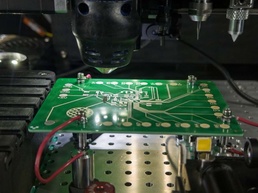
The Armaments Center took the lead on AME, with support from the Marines from the 3rd Maintenance Battalion and commercial collaborator Sciperio, and spearheaded experiments. The teams sought to resolve what planners called the “tyranny of distance,” as should an important component break while on a remote island, waiting for a new part from the United States could result in an adverse mission outcome. Using highly specialized systems, operators showed they could lay down conductive ink to draw working circuit lines and trace connections on demand.
Deploying such technology in a tropical climate came with its own set of challenges, as in the heat the conductive silver inks used to print circuits could cure too early, and salt spray from the ocean is a significant threat through corrosion. Before they could even face these tests, the printers had to survive the journey – several were damaged in transit, requiring troubleshooting and field engineering to get the machines running.
According to Venema, it took some time for the Marines to acclimate to the printers, but once they did, they showed considerable creativity, especially when the team printed out custom flexible antennas as a test. Senior enlisted communications personnel and officers with deep field experience immediately saw great potential. They began brainstorming ways to use AME to replace tactical antennas with lighter, more cost-effective printed alternates.
Additionally, using high-definition 3D scanners, operators were able to scan shattered mechanical pieces of gear, reverse-engineer them on a computer, and print a functional structural replacement on the spot.
Feedback remained highly positive, and the Marines gave the Armaments Center a request for the future: they need a simple, fast process to manufacture electrical components. The Armaments Center, leveraging NextFlex, a DoW Research and Engagement Manufacturing Innovation Institute, and its consortia members, plans to investigate automated diagnostics.
Instead of having to probe a circuit board for a break, one day a Marine will be able to drop a damaged card in the machine and just wait while an artificial intelligence system uses a camera and reference data to automatically locate the break, position the print head, and patch the damaged circuit line with conductive ink on its own.
Although fully automated diagnostics are still in development, 'guerrilla manufacturing' is a rapidly growing capability. By enabling the repair of circuit cards and the 3D printing of components at the point of need, the Armaments Center ensures frontline warfighters can actively manage and sustain their own supply lines during future conflicts, eliminating critical delays.