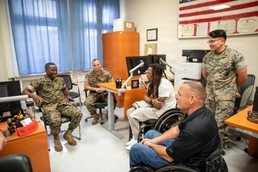
LANDSTUHL, Germany – Nearly two decades after they were evacuated from combat with life-threatening injuries, two Marine Corps veterans returned to Landstuhl Regional Medical Center (LRMC) July 29–not as critically-wounded patients, but as survivors.
Michael Delancey and Anthony McDaniel came back with a simple purpose: to thank the medical professionals that saved their lives.
“Thank you for what you did for me," Delancey told LRMC staff. "The care I received, from that critical moment in Iraq all the way to Bethesda, was seamless.”
Delancey said he spent 41 days in intensive care and remembers little of his time at LRMC, or the first week of his recovery at Walter Reed Army Medical Center.
“I don’t remember being here,” he said. “But I know I am alive because of the care I received.”
Nearly 20 years ago, then Lance Cpl. Mike Delancey was critically wounded during combat operations in Haditha, Iraq. On Sep. 1, 2006, a sniper’s bullet entered through his left shoulder, shattered three vertebrae, injured his right shoulder, and fragmented into his lung. He went into cardiac arrest five times before medical teams stabilized him and evacuated him through LRMC before his transfer to Walter Reed.
The injuries left him paralyzed below the T5 vertebra and permanently altered the course of his life.
“For nearly two decades, I've thought about the faces I couldn't see and the hands that worked so hard to keep me alive,” Delancey said. “You didn't just save my life; you gave me the chance to live one.”
Delancey’s story is one shared by many service members who passed through LRMC during the wars in Iraq and Afghanistan.
Fifteen years earlier, former Sgt. Anthony McDaniel, experienced a similar journey after he was critically injured while serving as an artilleryman with the 3rd Battalion, 12th Marines, during combat operations in Kajaki, Afghanistan, in August 2010. Like Delancey, he was evacuated to LRMC before continuing treatment in the United States.
During the visit, McDaniel asked the physicians about one of the most critical decisions in combat casualty care. “Who ultimately decides when a wounded service member is stable enough to make the flight back to the States?” McDaniel asked.
Maj. Adam Lloyd, chief of critical care at LRMC, explained that the hospital’s mission extends far beyond stabilizing patients.
“We only clear a patient for transport once they are medically stable, ensuring we don’t introduce unnecessary risk during the long flight across the Atlantic,” Lloyd said. “Our goal is continuity of care, not simply preparing someone for the next flight.”
Lloyd said visits from former patients serve as a meaningful reminder of why medical teams dedicate themselves to the demanding mission.
“It is incredibly rewarding to see service members return after rehabilitation and share what they’ve accomplished since leaving LRMC,” he said.
Col. Warren Stewart, commanding of LRMC, described the hospital as a vital link between the battlefield and families waiting back home.
“We are the bridge from the combat zone back to the families in the United States,” Stewart said. “This is our legacy.”
He said the veterans’ accomplishments since recovering demonstrate the lasting impact of the care provided by countless medical professionals over the years.
"When the next generation of wounded warriors comes through these doors, another team will stand where we stand today,” Stewart said. “Seeing patients from 2006 and 2010 return reminds us how far trauma care has advanced and why this mission matters.”
Since 2003, LRMC has continually refined its combat casualty care system, contributing to the highest battlefield survival rates in U.S. military history, Stewart said.
“When wounded warriors retrace their steps back to us, it restores our sense of purpose,” he said. “Especially on difficult days, seeing what patients have gone on to accomplish reminds us why we do this.”
Lloyd emphasized that no single person saves a wounded service member.
“This is an enormous team effort that begins at the point of injury, and continues through aeromedical evacuation, the clinicians here at LRMC, and the teams in the United States,” Lloyd said. “It is that coordinated system working together that saves lives.”
As Delancey and McDaniel traveled the halls where they once fought for survival, their visit served as a powerful reminder for LRMC staff that trauma care extends far beyond the operating room.
For caregivers who often see patients during only their most critical moments, the opportunity to witness decades of recovery, family milestones and successful lives offers a rare glimpse into the lasting impact of their work.
“I am not just surviving, I am thriving,” Delancey said. “I am so thankful for the outstanding care that I received here.” McDaniel echoed that sentiment.
“Because of the care I received, I am able to enjoy life,” McDaniel said. “I am currently a member of the U. S. Paralympic rugby team and recently trained with the German national Paralympic team.”
Stewart reflected on his own experience as a trauma nurse during the wars in Iraq.
"In Iraq, I rarely learned what happened after patients boarded the aircraft,” Stewart said. “But I knew that once they reached LRMC, their chances of survival were extraordinarily high.”
Looking at Delancey and McDaniel today, Stewart said, medical teams see more than former patients.
“We see our legacy,” he said. “We see the beautiful lives you’ve build because an entire chain of survival; from the Marine who applied the tourniquet on the battlefield to the trauma surgeons, nurses and evacuation crews, all working together to give you that opportunity.”
“You are the reason we are here,” Stewart said. “You are our purpose."