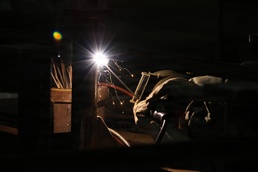
YOKOSUKA, Japan - Workers at the U.S. Navy's Ship Repair Facility and Japan Regional Maintenance Center (SRF-JRMC) successfully utilized a precision welding technique, called heat-controlled welding, resulting in an estimated 700 man-days of saved labor during a recent, complex shipboard overhaul.
The challenge arose during a maintenance availability requiring extensive work on the ship’s Recovery Assist, Secure, and Traverse (RAST) system, a specialized helicopter-handling unit. Instead of proceeding with the time-consuming and labor-intensive procedure, the project’s zone manager and welding shop specialists turned to heat-controlled welding. This innovative approach allowed technicians to complete critical work on a forward-deployed naval vessel without a system-wide teardown, keeping the ship on schedule and ready to return to the fleet.
"Saving 700 man-days is not just a technical victory; it is a testament to the power of our combined U.S. and Japanese team," said Kyouhei Kobayashi, the zone manager for the project. "From the initial shop mock-up to the final shipboard implementation, our technicians shared expertise and worked side-by-side in extremely challenging conditions."
The technique involves meticulous management of pre-heat, interpass temperature, and post-weld heat treatments. By controlling the weld’s thermal properties, the team performed the necessary structural integrations in place, working in tight spaces and avoiding the need to dismantle surrounding equipment. This was critical for integrating new systems into an existing hull while preserving structural integrity and protecting sensitive electronics.
To ensure mission safety and technical soundness, the procedure was rigorously validated before being used on the ship. They performed a shipboard proof-of-practice test in direct coordination with the fire safety officer, confirming the technique was safe and effective for the specific environment.
"We combined a deep understanding of U.S. Navy operational requirements with the meticulous precision of our Japanese master welders," said Norio Yanagawa, one of the project superintendents. "This incredible achievement was only possible because our U.S. and Japanese technicians seamlessly merged their respective strengths. Their flawless execution showed how we operate as one."
This maintenance procedure breakthrough is a reflection of the decades-long alliance between the United States and Japan. The joint efforts at SRF-JRMC demonstrate that the alliance is continuously forged on the deckplates through shared technical expertise, mutual trust, and a unified mission to keep the fleet forward-deployed and combat-ready.
For over 75 years, SRF-JRMC has been the linchpin of U.S. Naval operations in the region by providing intermediate and depot level repair for the ships of the U.S. Navy and the U.S. 7th Fleet.