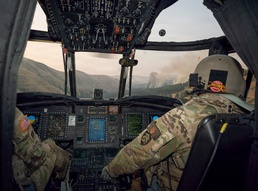
PENDLETON, Ore. — Two Oregon Army National Guard CH-47 Chinook helicopters and two HH-60M Black Hawk helicopters began water bucket operations July 29, 2026, in support of wildland firefighting efforts on the Hagen Fire in Umatilla County, part of a broader Oregon National Guard response to the state's 2026 wildfire season.
As of July 29, the Hagen Fire had burned approximately 33,504 acres and was 3% contained, according to the Oregon Department of Forestry. Aircrews completed 44 water bucket drops that day, delivering approximately 50,070 gallons of water on the fire.
The aircraft are flying out of Army Aviation Support Facility #2 in Pendleton, home to the Oregon Army National Guard's CH-47 fleet, after the unit received its State Active Duty activation order and completed Joint Reception, Staging, Onward Movement and Integration July 28.
"Currently, we're activated on state active duty for forest fires, and we just got the activation yesterday," said Maj. Taylor Fry, operations officer for Army Aviation Support Facility #2. "We have two CH-47s and crews that are out fighting these fires, along with two Black Hawks ... conducting those water bucket drops for those forest fire activities to support our local community, to save land, to save livestock and to save homes."
Fry said coordination with the Oregon Department of Forestry and partner agencies has been close, aided this year by fire management support from California.
"We work very well with them and have for many years," Fry said. "We have a couple of representatives from Cal Fire up here this year, helping us out with our helicopter management and coordination with them ... We get our missions from them. We get our guidance from them, and they use us as best they can to support their mission."
Behind every aircraft in the air is a maintenance team working to keep it there. Staff Sgt. Amanda Hickman, an aircraft systems supervisor at AASF #2, oversees the ground crew responsible for keeping the Chinooks flight-ready, including the water buckets themselves.
"There's a lot that goes into making sure that our buckets are operational," Hickman said. "The mechanics spend a lot of time making sure that all of our faults are minimized the best that we can. I do a little bit of production control, so a lot goes into verifying how much time I have available on each aircraft, and then setting priorities for which aircraft can fly and how many hours each aircraft can fly."
Hickman, who has served in the Oregon Army National Guard for 20 years, said aircraft turnaround time depends heavily on parts availability, and keeping it fast is one of the least visible but most demanding parts of the mission. "I like that the National Guard is being used for something to help our community, and so if I can play a part in helping the community, that's what I want to do," she said.
Once a Chinook is airborne, its crew chief takes on responsibility for the bucket itself. Sgt. Isaiah Torres, a Chinook crew chief, said the process starts well before the aircraft ever reaches a fire.
"It's almost the same as for any other flight, except you have to get the bucket ready," Torres said. "We get our bucket staged ... inspect the bucket, make sure valves are good. We do an op check before we actually take the bucket to the target site."
In flight, Torres said two crew members work in the back of the aircraft to guide the pilots over the fire and monitor the load.
"Once that bucket's over that fire, I release the trigger on a handle. Water dumps, water's away," Torres said. "We go back to the dip site. We get more water. Simple as that."
Torres, who has served as a crew chief for two years, said the mission carries a sense of purpose that training flights don't.
"It's better than just training flights. I think we're actually doing our job, which I enjoy," Torres said. "I've never been in a helicopter before the Army, so it's a pretty cool experience."
Fry said the biggest challenge of sustaining the mission isn't equipment or coordination, but people — Oregon Army National Guard members balancing the activation with civilian jobs and families during peak summer months.
"It takes our citizen Soldiers away from their full-time jobs and their families," Fry said. "But the best part about this organization is that everybody is willing to do that, and everybody is willing to give up their summers and their time to come and support this mission to support the state."
Fry added that the Guard members flying and maintaining the aircraft are, in many cases, the same people Oregonians see every day.
"These people are your neighbors. They're your friends," Fry said. "They're out here supporting you, supporting the state, and supporting our interests to keep the state safe and beautiful."
Gina Miner, Assistant Area Director for Oregon Department of Forestry's Eastern Oregon Area, said aircraft are expected to continue supporting firefighting efforts as long as they are needed, which will be based on conditions on the ground.