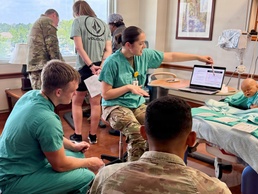
JOINT READINESS TRAINING CENTER AND FORT POLK, La. — Military medical professionals train for emergencies long before they happen, and Bayne-Jones Army Community Hospital is applying that same philosophy to maternal and newborn care through its annual Labor, Delivery, Recovery and Postpartum Skills Fair.
The three-day event held July 28–30, brought together 31 staff members from across the hospital to strengthen clinical competencies through hands-on training designed to improve patient safety and readiness. Participants rotated through six instructor-led stations focused on high-risk, low-frequency procedures and emergency response skills essential to maternal and newborn care.
Col. Patrick W. Miller, commander of BJACH, said events like the skills fair strengthen the clinical readiness that enables the Defense Health Agency to deliver a ready medical force in support of military operations.
“I am proud of our team for taking the initiative to build training that strengthens clinical confidence and improves outcomes for the mothers and newborns entrusted to our care,” Miller said. “Health care delivery is combat support, and events like this sustain the medical warrior currency required to deliver warfighter medical readiness. We must prepare with the same speed and urgency the mission demands. I hope other military treatment facilities will adapt this model to their own needs, so their teams are ready to respond without hesitation when every second matters.”
For Lt. Col. Shemica Ward, chief of BJACH LDRP, the skills fair reflects the Army’s approach to readiness by preparing medical teams before emergencies occur.
“The military always says, ‘Train as we fight,’” Ward said. “As health care professionals, an emergency can occur at any time, and we need to be prepared to ensure we act appropriately and in a timely fashion.”
The skills fair featured subject matter experts from LDRP, the Emergency and Pathology departments, respiratory therapy and perioperative nursing. The six stations included umbilical cord blood gases, newborn metabolic screening, emergency cesarean section preparation, Optiflow respiratory therapy, newborn APGAR assessments, and crash cart and defibrillator operations.
Rather than relying solely on online training or classroom instruction, participants practiced each skill using simulation equipment in an open-rotation format that allowed staff to complete stations during low-acuity periods while minimizing disruptions to patient care. Dedicated training sessions for night-shift personnel ensured all staff had access to the same hands-on learning opportunities.
Ward said the collaborative approach is especially important for rural military treatment facilities, where every member of the health care team may be called upon during an emergency.
“In small rural hospitals, staffing and resources are limited, so hands-on training gives staff the opportunity to focus on underutilized skills,” Ward said. “During an emergency, we rely on everyone to come together. Involving all departments gives team members the opportunity to learn from one another before they’re called upon to work together during an emergency.”
Lt. Col. Carmen Salcedo, assistant deputy commander for nursing at BJACH, said bringing together subject matter experts from multiple disciplines allows clinicians to learn from the people who perform these procedures every day.
“Everybody has a level of expertise that contributes to patient care,” Salcedo said. “We want the subject matter experts teaching these skills because they’re the ones performing them every day. They can share current best practices and real-world experience that strengthens the entire team.”
Salcedo said the skills fair also helps clinicians maintain competency as health care continues to evolve.
“Health care is constantly changing,” she said. “These skills fairs refresh critical clinical skills, keep staff current on changes in equipment, policies and evidence-based practice, and help ensure every member of our nursing team is ready to respond when needed.”
As the event coordinator, Sgt. Annamaria Gilley, LDRP noncommissioned officer in charge, said success isn’t measured by completing training stations—it’s measured by the confidence participants take back to their units.
“I hope participants leave with the hands-on confidence to jump right in and use these skills on their units across the facility,” Gilley said. “It’s about taking what they practiced here and feeling completely ready to do it on a real patient without hesitation.”
Gilley said that confidence can make all the difference during a maternal or newborn emergency.
“When a baby needs immediate respiratory support or when we have to open a C-section in a rush, there is no time to hesitate,” Gilley said. “Having that physical muscle memory means the team can jump into action instantly and work together seamlessly, which can improve patient outcomes and save lives.”
Looking beyond BJACH, Gilley believes the model could benefit other military treatment facilities, particularly those serving rural communities.
“My biggest advice is to look at areas of risk that aren’t done very often, especially in smaller, more rural military treatment facilities,” Gilley said. “When you don’t see these high-risk scenarios every day, keeping those skills, sharp is even more critical. Make sure to include the night shift in your planning because emergencies don’t just happen during the daytime, and every member of the team deserves the same opportunity to be ready when patients need them most.”