When the wind Picks Up, Safety Matters
High winds in the Mojave Desert can create hazardous driving conditions, knock out power, topple trees and scatter debris across Marine Corps Logistics Base Barstow, making preparation essential for Marines, civilian employees and families.
A hazard to be cautious about includes day-to-day activities that are inevitable, like driving. A windy day can turn a normal drive to work into a more dangerous one. It is important to be vigilant of fallen trees, objects on the road, potholes, and animals. Winds can be unpredictable and dangerous, and it is vital to always keep an emergency kit in the vehicle and replace it every so often to maintain the working condition of the product according to Brian Korves, base safety specialist and traffic safety manager. Korves suggests the following items be part of your emergency kit:
•A properly inflated spare tire, wheel wrench and tripod jack
•Jumper cables
•Tool kit
•Multipurpose utility tool
•Flashlight and extra batteries
•First aid kit with gauze, tape, bandages, antibiotic ointment, aspirin, blanket, nonlatex gloves, scissors, hydrocortisone, thermometer, tweezers, and instant cold compresses.
•Nonperishable, high-energy foods, such as unsalted nuts, dried fruits and hard candy.
•Drinking water
•Phone charger
•List of emergency contacts
Crosswinds can make driving more difficult or unsafe, and when driving through a crosswind, or gusts of over 20 mph, there are certain cautionary measures that can help the experience become more manageable.
“Keep both hands firmly on the steering wheel, reduce your speed by 10-15 mph, and be prepared to steer slightly into the wind to maintain your lane position,” Korves said. “Make small, gradual corrections, rather than sudden steering movements. Increase following distance to 4-5 seconds to allow reaction time for wind-induced vehicle movements.”
Springtime is usually the time of year when the high winds are a cause for concern, so fall is the perfect time to prepare for strong winds.
“Know your vehicle's limitations in wind conditions,” he said. “Practice handling techniques in safe and controlled environments and identify safe stopping points along regular routes. Always keep emergency supplies in your vehicle.”
According to Korves and the national safety council, if you see reports of wind gusts of 35 mph or higher, it is advised to stay home. Avoid driving when: Wind speeds exceed 35 mph sustained and gusts are forecast over 50 mph. However, if an emergency should arise, there are a few things to consider:
•Monitor weather conditions continuously
•Have backup transportation plans
•Delay travel
•Use different routes
•Communicate your travel plans with family or colleagues
•Trust your instincts; if conditions feel unsafe, they probably are
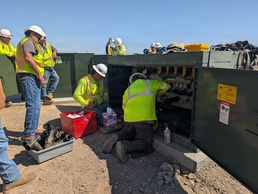
Public Works completed a three-phase utility restoration project in June 2026, replacing aging sulfur hexafluoride gas-insulated switchgear at the Nebo Annex South Loop, according to Christopher Yip, Project Management Engineering Branch Head. He further explained that the upgraded electrical distribution system restores dual-source power capability, significantly enhancing grid resilience and minimizing potential downtime during power outages for housing complexes, the Child Development Center, the RV area, and southwest critical infrastructure.
Older infrastructure may pose a higher risk of damage and shortages during windstorms. The base facilities team has procedures in place if the power goes out or any essential duties are affected.
There are procedures in place if a power outage does occur and these can help maintain services operating safely and securely.
“To keep essential services running smoothly, buildings supporting essential services are equipped with backup generators that automatically kick on during an outage,” said Alicia Florez, SF Facilities director. “For other key locations, we maintain a number of smaller, mobile generators that our teams can rapidly deploy to provide temporary power until power is restored.”
For more information on how to mitigate strong wind-induced disasters or for resources on safety protocols during high winds, please contact the Base Safety Office at (760) 577-6266 or the SF Facilities Public Works Help Desk at (760) 577-6220. If there is a downed power line or immediate danger, please contact 911. If you do call 911, please remember that they are located off-base. Therefore, you may need to give them very specific location details.