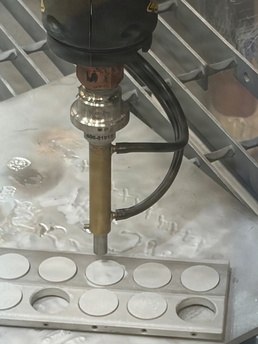
When Fleet Readiness Center Southwest (FRCSW) returns an aircraft to the Fleet, every component must meet exacting standards for safety, reliability, and performance. Behind that effort is a capability that has quietly supported naval aviation for over 90 years, the FRCSW Materials Laboratory.
Established in May 1936 at Naval Air Station North Island (NASNI), the laboratory was the first field aeronautical materials laboratory in the U.S. military. Created to provide immediate scientific and engineering support to aircraft maintenance operations, the lab fundamentally changed how the Navy investigated material failures, prevented corrosion, and improved aircraft reliability. Today, its work remains an essential part of FRCSW's mission to deliver combat ready aircraft to the Fleet.
The laboratory's story began with Stanley L. Chisholm, a chemist and metallurgist whose education at the Massachusetts Institute of Technology, doctoral studies at Harvard University, and experience in military and industrial research uniquely prepared him for the task.
When Chisholm arrived at North Island, however, there was no laboratory waiting for him.
Instead, he found a small corner of a former oil reclamation plant equipped with little more than a handful of used test tubes, beakers, work benches, and one enlisted assistant. Funding was scarce and every resource had to be carefully conserved. Family members later recalled that even household pickle and jelly jars became sample containers for aircraft oils and other fluids, illustrating the resourcefulness that characterized the laboratory's earliest days.
Despite those humble beginnings, Chisholm built a capability unlike any other in naval aviation.
Prior to the laboratory's establishment, aircraft material samples often had to be shipped hundreds or thousands of miles for analysis, delaying investigations and slowing maintenance decisions. By bringing scientific expertise directly to North Island, the new laboratory enabled engineers to rapidly identify failed materials, determine root causes, evaluate repair methods, and establish maintenance standards that improved aircraft reliability across the Fleet.
Its mission quickly expanded beyond routine testing. One of the laboratory's earliest and most influential projects examined aircraft engine oil degradation. Through a five year investigation, the team demonstrated that oil change intervals could safely be extended well beyond existing Navy requirements. The result significantly reduced maintenance requirements while saving the Navy millions of dollars in both time and resources and dramatically improving fleet readiness.
Other early efforts focused on corrosion prevention, aircraft preservation during storage, protective coating systems, and improvements to aluminum anodizing processes.
Chisholm's contributions earned recognition throughout his career, including a commendation from Secretary of the Navy Frank Knox for improving anodizing processes that enhanced corrosion protection for aluminum aircraft components. In 1952, he received the Navy's Meritorious Civilian Service Award for developing an aircraft cylinder restoration process that improved maintenance efficiency while reducing repair costs. Throughout his career, he also authored numerous technical papers and earned a patent advancing corrosion protection technology.
While Chisholm's accomplishments were significant, the laboratory's greatest achievement has been its continued evolution.
As naval aviation advanced from piston powered aircraft to modern high performance platforms, the Materials Laboratory expanded its capabilities to meet increasingly complex engineering challenges. Chemical analysis, metallurgy, failure analysis, corrosion science, process evaluation, and non destructive investigations became integral to depot level maintenance and aircraft sustainment.
Today, the laboratory continues to provide critical engineering support across FRCSW's maintenance operations. Its personnel analyze failed components, evaluate materials, support repair development, investigate corrosion, validate maintenance processes, and solve complex engineering problems that directly impact Fleet readiness.
Read about the FRCS Material Lab here: https://www.navair.navy.mil/news/Spotlight-FRCSWs-Materials-Lab-Machine-Shop/Thu-05022024-1321
The laboratory's enduring value lies not only in the technology it employs but also in the expertise of the workforce that carries its mission forward. For generations, scientists, engineers and technicians have built upon the standards established in 1936, ensuring that technical excellence remains a defining characteristic of FRCSW.
As the Navy prepares for future operational challenges, the importance of advanced materials science and engineering continues to grow. New aircraft, evolving technologies, and increasingly demanding operating environments require innovative engineering solutions and disciplined technical expertise.
The FRCSW Materials Laboratory is well positioned to meet those challenges.
Nine decades after its founding, the laboratory remains a vital contributor to naval aviation maintenance and a key enabler of Fleet readiness. What began as the U.S. military's first field aeronautical materials laboratory has grown into an indispensable capability supporting the readiness, resilience, and the lethality of Naval Aviation.
Its history reflects more than the accomplishments of one individual. It is the story of an organization built on innovation, sustained by generations of dedicated professionals, and committed to ensuring America's warfighters receive safe, reliable, mission ready aircraft.
FRCSW Employees are the Backbone of Military Readiness!