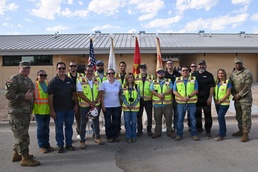
The U.S. Army Corps of Engineers’ Fort Worth District, joined Army leaders, industry partners, and elected officials to celebrate the ribbon-cutting of innovative 3D-printed barracks at Fort Bliss, marking a significant milestone in military construction and the future of Army infrastructure.
The project, the largest 3D-printed military housing development in the Department of Defense, demonstrates the potential of additive construction to deliver durable facilities while reducing construction time, material waste and long-term costs.
The project culminated after nearly two years of collaboration between USACE, the Army, Fort Bliss, and ICON, the Austin-based construction technology company which printed the structures.
"We are extremely excited about the potential that 3D-printing represents yet another construction technique available for the Nation," said Brig. Gen. George Walter, commanding general of the U.S. Army Corps of Engineers’ Southwestern Division. "As we seek to deliver our projects with increasingly efficient manners, we will continue to utilize all available technology. We are very thankful for our relationship with Fort Bliss, ICON and IMCOM."
The 10 buildings are constructed using ICON's large-scale robotic printer, which placed successive layers of a specialized cementitious material to create the walls of each structure. Once the printing process was complete, traditional construction methods were used to install roofing systems, windows, doors, utilities, HVAC systems and interior finishes.
Each barracks building was designed to meet stringent Army standards while demonstrating potential benefits of additive construction, including increased resiliency, reduced material waste, improved energy efficiency, and enhanced structural performance.
Construction began in early March 2026, and a first bead ceremony was held on March 26, showcasing the beginning of a new chapter in military construction. Since then, crews have worked to transform the printed shells into fully operational facilities ready to support soldiers stationed at Fort Bliss.
“These facilities were fully 3D-printed in just 58 days,” said Maj. Gen. Curtis Taylor, the Commanding General for the 1st Armored Division and Fort Bliss. “By leveraging this emerging technology, we built these barracks four times faster than the typical construction model and 9% less expensive than our initial estimates. Saving the taxpayer over $5.6 million just in overhead. But this project is more as much more than impressive statistics, 3D printing or cost savings.”
The Fort Worth District served as the lead USACE district overseeing project execution, contract management, quality assurance, and coordination among government agencies and industry partners.
"Today's ribbon cutting reflects the dedication of an incredible team of teams willing to embrace innovation while maintaining the highest standards expected by the Army for our warfighters," said Col. Calvin Kroeger, commander of the Fort Worth District. "These facilities demonstrate that emerging technologies can be successfully integrated into military construction without compromising quality, safety, or mission readiness."
ICON's proprietary printing technology allowed crews to automate much of the structural wall construction while improving precision and minimizing construction waste. The company said the project represents a milestone not only for military construction but also for the future of the building industry.
“I want to be direct about why speed matters for an installation like this and for our Army” said Will Hurd, President of ICON Prime. “Fort Bliss is not just a post. It is America's premier power projection platform. I know this because I used to represent Fort Bliss in Congress. The readiness of the soldiers who train and rotate through here has direct consequences on all of us, and on what the country can do in the world.”
The barracks will house soldiers assigned to Joint Task Force - Southern Border in support of Operation Ardent Vanguard, providing modern living spaces that support readiness and quality of life.
Army leaders emphasized that the facilities reflect the Army’s commitment to providing soldiers with modern infrastructure while exploring technologies that can improve construction capabilities across the Department of Defense.
“It's about combat readiness and most importantly, about taking care of our people,” said Taylor. “In a few short weeks, when the next rotational unit finishes a demanding shift on the border, they aren't going to drive an hour out into the desert. They're going to return right here to permanent, energy resilient, world class housing. It will be just a few steps away from our gyms, our dining facilities and our recreation areas.”
Lessons learned during the Fort Bliss project will help inform future USACE and Department of Defense construction efforts, particularly for projects where rapid construction, resiliency, and sustainability are critical considerations.
As the Army continues modernizing its installations, projects like Fort Bliss demonstrate how emerging technologies can complement traditional engineering expertise better suited for future operational requirements. The completion of these 10 barracks will mark a milestone for Fort Bliss and demonstrates that additive construction has moved beyond demonstration projects into full-scale operational use.