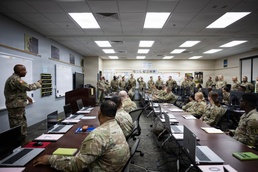
FORT LEE, VA - Command Sgt. Maj. Gregory Betty, the U.S. Army Reserve Command’s senior enlisted leader, spent July 28 at Fort Lee moving through classrooms, motor pools, training sites, and field kitchens - absorbing the sights, sounds, and Soldier‑driven energy that define the sustainment enterprise. His visit to the Combined Arms Support Command (CASCOM) offered a rare, ground‑level look at how today’s sustainers are being prepared for tomorrow’s fight. “Coming to Fort Lee today was to visit the Ordnance School, Quartermaster School and everything else just to see our Soldiers at the elite level,” said Betty. “To see the training they're getting here to come out and become our future Soldiers. Betty began his engagements with the 94th Training Division, where Reserve instructors deliver technical and leadership training across sustainment specialties. He spoke with cadre and students discussing how institutional training can better support Reserve Soldiers balancing civilian careers with military requirements. From the classroom to the maintenance bay at the Ordnance School, where instructors showcased how modernization is reshaping the way maintainers learn and operate. He moved through labs filled with humming equipment and Soldiers deep in hands‑on tasks. Additive manufacturing instructors demonstrated 3D printing training—a capability that allows maintainers to fabricate parts in the field, reducing wait times and increasing readiness. Betty watched students produce components on demand, a glimpse into how sustainment formations are becoming more agile and self‑sufficient. Nearby, weapons maintainers walked him through the Next Generation Squad Weapon systems. Betty examined the new platforms, asked questions about maintenance challenges, and discussed how Reserve Soldiers will integrate these systems into their formations. He concluded the Ordnance portion of his visit inside the wheeled vehicle maintenance bays, where Soldiers were troubleshooting engines, replacing components, and demonstrating the technical proficiency required to keep the Army’s tactical fleet mission‑ready. From the motor pool, Betty moved to the Quartermaster School’s Tactical Field Readiness Training Center, where culinary specialists train to feed Soldiers under austere conditions. Soldiers training to be the Army’s newest 92G Culinary Specialists, unpacked the Assault Kitchen - a lightweight, rapidly deployable feeding system designed for small units on the move. Betty observed how quickly Soldiers could set up the equipment and begin preparing meals. He then watched trainees demonstrate field feeding training, showcasing how they adapt recipes, manage rations, and maintain sanitation standards in the field. The command sergeant major was served hot field chow, giving him a firsthand sense of the quality and efficiency of modern field feeding operations. The day culminated with CASCOM Reserve Component briefings and dialogue, giving Command Sgt. Maj. Betty and CASCOM leaders the opportunity to align priorities, discuss modernization pathways, and strengthen integration between the active and Reserve sustainment communities. Throughout the visit, Betty emphasized that direct visibility, seeing Soldiers train, watching instructors teach, and engaging with leaders on the ground is essential to understanding how the Army Reserve can best support the Total Force. “I love that we have the schoolhouse,” said Betty. “Total Army Training Center, where we have all three components learning together. That's how we fight! We fight together!”