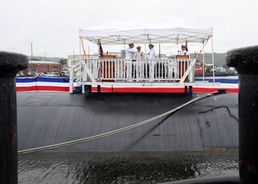
GROTON, Connecticut– Capt. Phil Castellano turned command of Submarine Squadron (SUBRON) 12 over to Capt. Thomas Bullock in a traditional change of command ceremony held Thursday, July 30, pierside at Naval Submarine Base New London in Groton, Connecticut.
Vice Adm. Richard Seif, commander, Submarine Force Atlantic, presided over the ceremony and served as guest speaker.
"In an era of intense strategic competition, the United States Submarine Force remains the most lethal, survivable, and capable asset in our nation’s arsenal," said Seif. "This waterfront is our center of undersea combat power, America’s undersea arsenal of apex predators. At the absolute leading edge of that mission is Submarine Squadron 12."
Castellano praised his staff, submarine commanding officers and crews during his remarks, stating, “no matter what you are doing, keep warfighting first.”
“When I took command of this squadron, my guidance was to be default aggressive in everything we do and to be ready to engage and kill the enemy at all times,” said Castellano. “I didn’t want a staff that managed paper; I wanted a staff that forged weapons. We don’t wait for things to happen—we dictate the terms of the fight.”
Castellano, a Tampa Bay, Florida, native and 2000 graduate of Jacksonville University, will continue serving as director, Tactical Analysis Group, Undersea Warfare Development Center. His previous submarine tours include USS Asheville (SSN 758), USS Georgia (SSGN 729), USS Pasadena (SSN 752) and USS Toledo (SSN 769).
“The results speak for themselves: this squadron outpaced every other Atlantic submarine squadron by generating an unprecedented 58 percent of all operational coverage in the European theater,” said Castellano. “When national security was on the line during ‘once-in-a-generation’ national tasking and international crises, Submarine Squadron 12 met every requirement and rapidly surged lethal options to our operational commanders.”
Bullock thanked Castellano for his leadership, dedication and stewardship while leading SUBRON 12, leaving behind a “legacy of strength.”
“The culture of excellence on this waterfront is a direct reflection of your drive and commitment to these crews,” Bullock said.
Bullock, a Woodbridge, Virginia, native and graduate of Penn State University and Rutgers University, where he graduated with Bachelor and Master of Science degrees, respectively, arrives at Squadron 12 after serving as chief, Mission Assurance Branch, Joint Chiefs of Staff. His previous submarine tours include USS Memphis (SSN 691), USS Annapolis (SSN 760), USS Columbia (SSN 771) and USS Asheville (SSN 758).
“The submarine force has entrusted the Squadron 12 staff with the duty to train and certify your teams to operate some of the most complex, high-consequence technology on Earth, and to do so at the absolute limits of an unforgiving environment,” Bullock said. “As I take command today, I embrace that solemn responsibility with you."
SUBRON 12’s mission is to provide attack submarines that are ready, willing, and able to meet the unique challenges of undersea combat and deployed operations in unforgiving environments across the globe. It is one of two SUBRONs based out of SUBASE New London, alongside Submarine Squadron 4, commanded by Capt. Thomas Flaherty.
Fast-attack submarines are multi-mission platforms enabling five of the six Navy maritime strategy core capabilities – sea control, power projection, forward presence, maritime security and deterrence. They are designed to excel in anti-submarine warfare, anti-ship warfare, strike warfare, special operations, intelligence, surveillance and reconnaissance, irregular warfare and mine warfare. Fast-attack submarines project power ashore with special operations forces and Tomahawk cruise missiles in the prevention or preparation of regional crises.