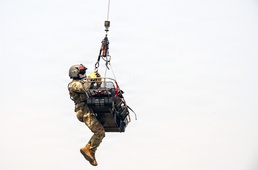
HELENA, Mont. — Soldiers assigned to Charlie Company, 1st Battalion, 189th General Support Aviation Battalion recently completed instructor certification on the VITA Rescue System, a new hoist rescue capability that enhances stability during helicopter rescue operations and improves patient recovery in challenging environments.
The two-day training brought together instructor pilots, flight instructors and rescue personnel who will now train the remainder of the company's UH-60 Black Hawk medical evacuation crews. Once fielded, the VITA Rescue System will be based in Helena and Billings, providing a statewide capability to support search and rescue missions, medical evacuations and emergency response operations across Montana.
The VITA Rescue System is mounted beneath a litter and actively stabilizes the patient during hoist operations. By reducing unwanted spinning and oscillation caused by rotor wash, wind and aircraft movement, the system allows rescue crews to maintain greater control while recovering patients from difficult terrain.
"This is a train-the-trainer event," said Chief Warrant Officer 3 Tom Kinyon, Charlie Company training officer. "We're certifying our instructors so they can train the rest of the company to safely employ the system during future rescue missions."
Charlie Company provides the Montana Army National Guard's rotary-wing medical evacuation capability and routinely trains to conduct hoist rescues throughout the state's mountains, forests and remote backcountry. The addition of the VITA Rescue System expands the unit's ability to safely recover patients in environments where precision and stability are critical.
"The system helps stabilize and control the litter, making the job easier for both the medic and the hoist operator during patient pickup and recovery," said Capt. Otis Smith, commander of Detachment 1, Charlie Company. "It provides a smoother, more controlled recovery and enhances safety for both the patient and the rescue crew."
The soldiers that attended the initial certification course will serve as the unit's primary instructors. Over the coming weeks, every medic, crew chief, hoist operator and pilot involved in hoist operations will complete qualification training.
"We'll have everybody trained over the next couple of weeks," Smith said. "From there, it becomes part of our recurring training to make sure every crew stays proficient."
Before fielding the VITA Rescue System, rescue crews often relied on physical techniques to counter spinning during hoist operations or used external taglines to help stabilize the litter. The new system minimizes unwanted movement while remaining attached to the litter throughout the rescue, allowing crews to focus on patient care and aircraft operations.
"We've conducted hoist rescues for years, but this gives us another layer of safety," said Staff Sgt. Randy Scales, Charlie Company readiness noncommissioned officer. "It protects our patients, helps stabilize the litter throughout the hoist and gives our crews greater control during the recovery."
Montana National Guard Soldiers also participated in earlier prototype evaluations of the system, providing operational feedback that helped refine the final design before it entered production.
"I think it's a well-designed system," Scales said. "The feedback from crews that tested the prototype was incorporated into the final product, and I think it's going to become a valuable capability as we continue training and gain experience with it."
As the system is integrated into routine flight operations, aircrews will continue building proficiency to ensure they are ready to respond whenever called to support military operations or assist civil authorities during search and rescue and medical evacuation missions across the state.