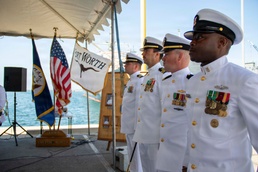
SAN DIEGO (July 29, 2026) – Freedom-variant littoral combat ship USS Fort Worth (LCS 3), and the crews who have manned it, were recognized during a decommissioning ceremony held at Naval Base San Diego, July 29. Fort Worth and its crew played an important role in the defense of our nation and maritime freedom and served as an operational unit and test platform. Fort Worth’s final Commanding Officer U.S. Navy Cmdr. Dana Canby reflected on the service of his crew and the legacy that the ship will leave behind.
“To the last Rough Riders, I’m incredibly proud of the work you’ve put into the ship through really challenging circumstances, and I am so excited to hear about the great things you’re going to do as you go to your next ships,” said Canby. “As Fort Worth sails into the sunset, these Rough Riders will carry on the ship’s legacy; they will move on to make other ships and the Navy more lethal and more capable.”
The guest speaker and former Secretary of the Navy, Honorable Gordon England, wished the current crew fair winds and following seas as they bid farewell to their ship.
“As we celebrate our 250th year as a free nation, and home of the brave, it is instructive to look back at the birth of our Navy. George Washington said, ‘Without a decisive naval force we can do nothing definitive.’ That decisive naval force has stood the watch and protected America every single day of the 250 years,” said England. “Looking back recalls heroic and famous ships, like the USS Constitution, the USS Enterprise and the USS Texas. The name USS Fort Worth now stands alongside those ships in the annals of the Navy.”
England oversaw the development of the ship and advocated for it to be the first ship named after the city of Fort Worth. “Today is very personal to me as one of the 29 original blue crew Sailors who moved aboard Fort Worth back in June of 2012. Although today marks the end of Fort Worth’s commissioned service, it is not the end of her story. Over the past 14 years, Fort Worth’s crews were expected to not only operate the ship but to develop what the class could become, testing new ideas where they matter most – at sea. Fort Worth became a pathfinder manned by Sailors who continually defined the key traits of grit and tenacity,” said U.S. Navy Rear Adm. Matthew Kawas, commander, Carrier Strike Group Eight. “Fort Worth’s watch is ending, but her influence and legacy are not. Although the ship will fall silent, beyond her lifelines, her work will continue - that is the legacy of USS Fort Worth.”
Kawas, a 1995 graduate of the U.S. Naval Academy, is a plank owner of Fort Worth and served as the blue crew executive officer and later as its commanding officer.
Built by Lockheed Martin and Fincantieri Marinette Marine, in Marinette, Wisconsin, Fort Worth was designed as a test platform for the Freedom-variant LCS. Since its commissioning on Sept. 22, 2012, in Galveston, Texas, the ship has been at the forefront of testing and validating new naval technologies and warfare capabilities.
The ship made its mark in service, including completing the one of the longest deployments of the U.S. 7th Fleet area of operations to date, with 16 months at sea and more than 15,000 nautical miles traveled in the Western Pacific and becoming the first LCS to test an overseas preventative maintenance availability; a program that is still employed by LCSs today. Fort Worth also conducted experimentation with the first Anti-Submarine Warfare module for LCSs. After returning to its homeport of San Diego, Fort Worth once again served as a training platform. After the decommissioning and inactivation, the ship will be towed to the Naval Inactive Ship Maintenance Facility (NISMF) in Bremerton, Washington, where it will be placed in a dismantle status.
The decommissioning of Fort Worth supports the department-wide focus on investments in the most lethal programs, platforms and weapons that enable various types of naval operations. Littoral combat ships are fast, optimally manned, mission-tailored surface combatants that operate in near-shore and open-ocean environments, winning against 21st-century threats. LCS integrate with joint, combined, manned and unmanned teams to support forward-presence, maritime security, sea control and deterrence missions around the globe.
Commander, Naval Surface Force, U.S. Pacific Fleet ensures fleet commanders are equipped with personnel, materiel, and training required to project credible naval power at sea, ashore, at home and abroad. For more news from Naval Surface Force, visit https://www.surfpac.navy.mil/ and http://www.dvidshub.net/unit/COMNAVSURFPAC.