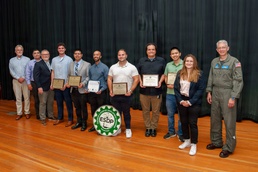
Rooted in resilience: ESDP class of 2026
Seventy-five emerging leaders, scientists, and engineers walked across the stage this July during two separate ceremonies – 20 graduates at Point Mugu on July 15 and 55 at China Lake on July 23 – marking a vital step forward for the Naval Air Warfare Center Weapons Division. These events celebrated the dedication, continuous growth, and future impact of the command’s civilian innovators.
This multi-year professional development program represents NAWCWD’s steadfast commitment to nurturing top-tier talent. Between March 2020 and December 2022, new hires joined the organization under the New Professional Program. In 2023, the command consolidated its training efforts and reverted to the Engineer and Scientist Development Program, or ESDP 2.0. The 2026 graduating cohort included graduates from both.
Over a span of up to five years, these 75 individuals completed rigorous program requirements. Guided by dedicated supervisors, managers, and mentors, they navigated extensive training, increasingly responsible tasks, and rotational tour assignments, proving their ability to deliver high-performance results at the journeyman level.
In their opening remarks, Executive Director Dan Carreno (speaking at Point Mugu) and Technical Director Andy Corzine (speaking at China Lake) highlighted that the future of national defense relies heavily on a diversity of thought and experience. This class, representing nearly 50 universities from across the nation, brings an incredible depth of skills and passions to their roles, they noted, and that’s by design.
Executing NAWCWD’s mission requires the best and brightest minds in fields ranging from AI to mechatronics to psychology and beyond. “It’s really, really important to have a lot of deep experience that can be passed on to folks, but it's equally important to have fresh ideas that you're bringing forward,” Corzine said. “We can't keep doing the things that we've been doing in the last eight decades and expect different outcomes. We've got to have you coming in and bringing those fresh ideas.”
This year’s graduates embody that needed diversity. While engineering remains the core of the program, the class features specialists in computer science, mathematics, statistics, physics, and even psychology and neuroscience. While leadership celebrated the healthy work-life balance these individuals maintain outside the office, the true highlight is how they connect their personal passions into highly technical defense roles.
From outdoor enthusiasts utilizing their terrain-mapping skills to test critical mission planning systems, to creative thinkers managing infrastructure recovery operations under extreme pressure, their personal talents enrich their professional capabilities.
Transitioning out of the structured environment of the development program and into broader defense roles requires flexibility. Guest speaker Felipe Jauregui, the division's chief technology officer and a 2009 program graduate, asked the cohort to embrace “adaptive agility” – learning to be like water and changing shape to meet new challenges.
Jauregui cautioned against the "lone wolf" mentality and insteademphasizedto the class that true strength lies in teamwork, drawing a powerful parallel to giant sequoias. While these massive trees survive brutal storms, their roots only run6 to 12feet deep. They stand tall because their root systems intertwine underground to support the entire grove. Heremindedthe cohort that their collective resilience serves as a safety net when individual muscles give out. "In our line of work, independence is a myth," Jauregui noted. "Interdependence is where we should really be looking."
This collective resilience is essential, as graduation served as a powerful reaffirmation of the command's mission: to deliver warfighters the decisive advantage so they can deter aggression, fight and win in conflict, and come home safely.
Rear Adm. Keith Hash, NAWCWD commander, reminded the graduates of the substantial responsibility they now face as journey-level professionals.
“Our world is not a safer place, and danger is growing,” Hash stressed, pointing out that the fleet relies on NAWCWD's innovations on the front lines every day. “We will only continue to provide that decisive advantage if we outthink, if we out-innovate, and we supply our warfighters what they need on a more urgent and quicker basis.”
The technology developed, tested, and evaluated by these young engineers directly impacts global security. Hash emphasized that because of their work, service members are coming home safely, but the job is far from finished. He challenged the graduates to view this not as an end, but as a beginning - time to step up, solve the hardest problems, and become mentors for the next generation of incoming talent.
As warfare evolves and the pace of technological advancement accelerates, standing still is not an option. These graduates are tasked with out-innovating those who mean the nation harm. Equipped with fresh perspectives, collective resilience, and the heart to protect and support, these 2026 graduates are ready to ensure the fleet remains unmatched. They are up to the challenge, and the command looks forward to seeing what they will bring to the team, and to the fight.