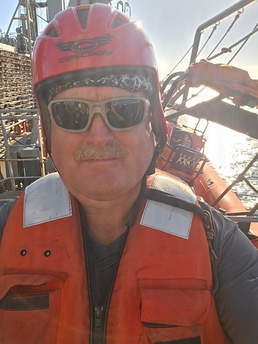
With almost 29 years of service across three sea-service communities, one Civil Service Mariner attached to Military Sealift Command (MSC) has carved out his own career path through hard work and dedication and sees no glass ceiling in his future.
Jason Chambers’ maritime journey started long before he joined MSC in December 2020. His lineage derives from a history of military and mariner background, dating back to WWII.
“I was a ‘military brat’ and moved all over the U.S.,” Chambers said. “My father served in the Air Force, my uncle served in both the Navy and the Marine Corps, my paternal grandfather retired from the Navy, and my maternal grandfather served in the merchant marines in WWII.”
Chambers now makes his own living sailing the seas as an ordinary seaman (OS) with MSC, but there was a time when he sailed the seas with a different community and provided a much different service to his maritime comrades.
“I joined the Navy right after high school in 1990 as a sonar technician and worked aboard a submarine,” Chambers said. “Eventually I changed my job rate to mess cook and transitioned to surface platforms where I completed a 10-year enlistment and ended my last duty station aboard an aircraft carrier.”
Chambers said when he left the Navy, he continued his maritime course, just in a different direction.
“After the Navy, I enlisted into the Coast Guard as a cook, eventually rising to the rank of Chief Petty Officer,” Chambers said. “In 2013, I retired with a culmination of 23 years of military service.”
Seven years later, Chambers joined MSC as a steward cook but attributes his recent job conversion to ordinary seaman to his past military experience.
“The Coast Guard allowed me to do more than just my rate when I was enlisted,” Chambers said. “Even though I was a cook, I also was able to serve as a quartermaster of the watch, small boat coxswain, and underway officer of the deck.”
But the military wasn’t the only contributing factor to his MSC career success, Chambers said it has taken a village of supporters who have helped him along the way.
“The most influential and important mentor I have had was the chief mate on board USNS Supply in 2024, Dana Mancinelli,” said Chambers. “Without her mentoring me and pushing me, I would still be a steward cook and unhappy with my position.”
Mancinelli said she believes a leader should know three things; Know yourself, know your job, and know your people.
“Within three days of meeting Jason, I knew he was ‘out of purpose.’ He had a successful leadership position as a line officer in the supply department on MSC ships, but he was not fulfilling his own purpose,” Mancinelli said. “He would tell stories of his Coast Guard days and ask questions about rigging and navigation. As a shipmate, I listened, engaged, and encouraged. Ultimately, he came up with his own plan and own idea, using his own time to forge a new path that, to anyone else, may have sounded ludicrous. To me, I just asked, “how can I help?”
Chambers said numerous navigators, cargo mates and third mates, and watchstanders contributed to his success at MSC, but the masters and chief mates helped the most.
“The master on USNS Comfort was able to get me transferred to deck department, and the chief mate on USNS Comfort ensured I got plenty of time in the crane,” Chambers said. “And on USNS Kanawha, the master and chief mate both allowed me to attend training and become a tankerman person in charge as well as rescue craft coxswain, even though I was an OS.”
Mancinelli said she could tell that Chambers was career motivated, and she knew he had an end goal in sight.
“The smile that he wore after coming down off the bridge the first time I asked if he wanted to steer the vessel was all the answer I needed to know that Chief Steward Chambers would be making a career change in the very near future. We spent many hours working through the assessment books for both the navigation watch, and the third mate,” Mancinelli said.“I know Jason will continue to climb the hawse pipe and any time I see or hear from him, I will ask, “how can I help?” until the day he relieves me on one of these ships.”
Chambers’s drive did not end there. Now, nearing his sixth year with MSC, driven by success and supported by his leadership, Chambers’s vision is clear.
“I’m working on my third mate license and should have it in two more years, and then I want to become a 2nd officer/navigator as soon as I can,” he said. “Once those are completed, I want to move forward and get my chief mate/master license.”
In his short time at MSC, Chambers has sailed aboard five ships, with his most recent mission being aboard the fleet replenishment oiler USNS Kanawha (T-AO 196) where the ship and her crew completed a 204-day deployment operating in the U.S. 4th, 5th, and 6th Fleets from February to May.
During the deployment, the ship supported Operation Epic Fury, providing logistical support, ultimately resulting in the ship becoming the first of two MSC ships to ever be awarded the Presidential Unit Award on July 17.
During the award presentation, several personal accomplishments were acknowledged to include Chambers and his contributions during the deployment.
“Ordinary Seaman Jason Chambers helped to sustain the ship’s Marine Sanitation Device and vacuum plumbing systems, preventing mission delays through rapid clog and leak resolution,” said Cmdr. Edward Prendergast, Operations Officer, Military Sealift Command Atlantic and master of ceremony for the event. Prendergast added that Chambers’ training “strengthened the entire deck department’s self-reliance.”
Chambers said taking charge of his career hasn’t always been easy, but the hard work has resulted in the successes that he has strived for.
“I had to dedicate my own time after 10-12 hours of being the chief steward to stand bridge watches, getting only about six hours of sleep for about six months, and because of my schedule, I could only stand one watch a day unlike the normal watchstanders who were standing two,” Chambers said. “I would give up my overtime and go to the bridge to get assessments done, and after deployment I paid out of my own pocket to attend advanced training.”
Chambers said once he began getting bridge training and obtaining signatures in 2023, he hasn’t stopped learning.
“Finally becoming an OS in June of 2025 was a happy day for me,” said Chambers. “I lost thousands of dollars per paycheck but my creditable sea time in the deck department started, and you can’t buy that.”
For younger mariners, Chambers said they can be as successful as they want to be if they plan their career and stay on course.
“Don’t settle for what you are given. Take command of your career,” said Chambers. “If there is training that MSC won’t pay for, pay for it yourself. You will make the money back and show others that you will not stop until the goal is reached.”
MSC exists to support the joint warfighter across the full spectrum of military operations, with a workforce that includes approximately 6,000 Civil Service Mariners and 1,500 contract mariners, supported by 1,500 shore staff and 3,500 active duty and reserve military personnel.