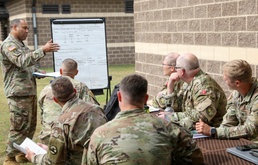
FORT MCCOY, Wis. --- For units deploying to a combat zone, understanding their training gaps can be the difference between mission success and defeat. Observer-controller/trainers, or OC/Ts, from the 84th Training Command, an Army Reserve Command at Fort Knox, Ky., observe, coach and train units, helping them identify areas for improvement to enhance overall mission success.
The OC/T Academy trains active duty, reserve and National Guard Soldiers, however, this year’s Class 26-12 included two officers from Denmark’s Home guard as part of the USAR expansion for the Military Reserve Exchange Program with this Ally. Lieutenant Col. Peter Moldrup, a Chile Liaison/ Region West with the Danish Home Guard and Capt. Ib Munk an Operations Officer with the Danish Home Guard attended the academy to exchange knowledge and gain perspective on allied nation training approaches.
The Military Reserve Exchange Program is an Office of the Secretary of War managed multinational initiative that offers U.S. Reserve Service members to temporarily attach to allied military units. The program boosts NATO interoperability and cross-cultural leadership skills through short-term, reciprocal annual training assignments.
The gap discovery process during each class iteration is strategically approached through the crawl, walk, run phases of planning and executing missions. Participants who demonstrate the ability to plan and execute a successful mission graduate from the course. They are then tasked with training their own units in mission-essential tasks, aiming to minimize training deficiencies
Danish Officer Lt. Col. Moldrup explained that he works a lot with civilians, and they do a lot with guarding with police and different government agencies. “I think I’ll try to find a way to phrase what I’ve learned here for them, so we can have a framework when we do the next exercise”, Said Moldrup.
Master Sgt. LaQuan Waters, a course manager and OC/T Academy graduate, elaborated on the course structure and how exchanging ideas with allied partners strengthens overall training. "Training with our allied partners is important for us as an armed force because it allows us to coordinate our strategic and tactical efforts, as well as standardize operational language and evaluations when it comes to the forces working together," Waters said
The exchange lands squarely on a national priority. The National Defense Strategy names a strong network of allies and partners as a decisive and enduring advantage that makes the force more capable and interoperable. Programs like MREP turn that strategy into muscle memory when American and allied Soldiers learn the same standards in the same field, they can plug into a coalition formation and operate as one.
Denmark has been a steady partner in that work. Since 2012 Danish Home Guard members have trained with U.S. Army Reserve formations, and U.S. Soldiers have deployed to Denmark through the same exchange to train with Danish units. The officers' interest in building their own OC/T capability is a sign the partnership is maturing moving from participating in exercises toward adopting the institutional practices that sustain a ready reserve force over time.
Back home, the two officers intend to use what they learned to help design The Danish Home Guard’s own observer controller/trainer program. During this visit they learned, what exercises they will be a part of, OC/T professionalism and doctrine, training and evaluation outlines, after-action reviews, Joint Lessons Learned Information System, Virtual Battle Space, and a final exam and briefing, collecting the curriculum, evaluation methods and lesson plans they can adapt to a Danish context.
"The bonds we build in training become the foundation of our operational effectiveness. When allied forces move as one, our adversaries face not a coalition of convenience, but a unified force of proven capability and shared commitment," said Maj. Gen. Kelly Dickerson, Commanding General 84th Training Command.