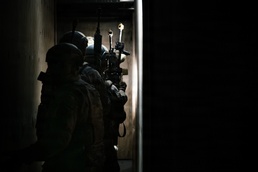
86th Airlift Wing Public Affairs KAPAUN AIR BASE, Germany – A 569th U.S. Forces Police Squadron patrolman barely settled behind the radio when reports began.
Routine status checks quickly turned into updates from the entry control point where a suspicious package redirected defenders across the training area. A drone spotted overhead and simulated casualties began reducing the number of Airmen available to respond. As opposing forces pressed the perimeter, every report passed through Senior Airman Rodney Richburg, the patrolman behind the radio, before moving to leadership.
For Richburg, It was his first time serving as a radio telephone operator during a field training exercise, there wasn’t much time to think about what came next.
“The radio was basically my whole job while everybody else was shooting,” Richburg said. “Patience is key. I had to gather the whole report of the situation before relaying it.”
Richburg was one of 14 defenders participating in the FTX that concluded two weeks of Security Forces Level 100 instruction with the 569th USPS. Instructors layered scenario after scenario, pressuring Airmen to apply classroom instruction whilst responding to an evolving defense of a simulated forward operating base throughout the day.
Staff Sgt. Kane Dew, 569th USPS lead training instructor, said the goal was never to create a perfect exercise, it was to create an environment where Airmen work together while managing competing priorities.
Instructors built the exercise around training injects to meet the objective, which are multiple scripted events that involve threats and prime concerns changing without warning, all designed to complicate the battlefield.
“When we do our field training exercises, we’re just throwing inject after inject after inject to see how the defenders respond.” Dew said.
The pace left little room to separate one obligation from another. Richburg wasn’t watching the exercise unfold from a command post. He was carrying his rifle alongside the rest of his team and balancing his responsibilities on the ground with a constant flow of radio traffic. He practiced gathering information, organizing reports and shifting attention to suspicious activity surrounding his patrol as new scenarios unfolded around him.
Moving through the wooded forest of the training area, Richburg recognized how the fundamentals in the classroom setting came into play. Conditions changed faster than any lesson plan could predict. Smoke bombs and flash grenades were detonated. Stressed Airmen spoke fervently through the radio. Flashes of gunfire and bullets flew all around. Screams of simulated injured personnel attempting to apply tourniquets echoed throughout the mock battle-field, all while ensuring to stay calm and lead the team.
Richburg now understood that communication was the foundation of every decision made on the field as more of his team went down during the exercise.
He depended on his teammates to provide accurate data from the field before he could relay a report through his radio. Those same teammates also depended on him to organize information into clear pictures that leaders could act on, reinforcing that no defender succeeds alone.
“Communication is the number one thing for mission success,” Dew said. “If you do not communicate, things get missed. When things get missed, people get injured.”
One defender’s observation became another defender’s decision, making transmission the thread that connected every position on the field.
“You have to trust the next person is going to have your back,” Richburg said. “Whether you’re clearing a room, calling in a medevac or standing at the gate, everybody has to do their job.”