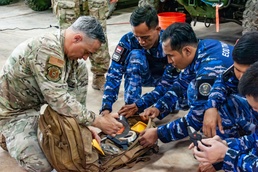
ANDERSEN AIR FORCE BASE, Guam – For the first time in their 20-year partnership, Hawaii Air National Guard and Indonesian Air Force Airmen came together for specialized Explosive Ordnance Disposal (EOD) training at Andersen Air Force Base, Guam, July 20-24.
The training brought together EOD experts from the 154th EOD Flight and Andersen Air Force Base’s 554th Rapid Engineer Deployable Heavy Operational Repair Squadron Engineers (REDHORSE) Squadron to provide Indonesian counterparts with the tools, resources and hands-on experience needed to conduct real-world EOD operations.
"The goal is to equip them with the skills and knowledge needed to respond effectively in all kinds of emergency situations," said Senior Master Sgt. Steven Dauck, 154th EOD flight chief. "After 20 years in EOD, I want to pass on the knowledge and experience I have gained, answer their questions, and ensure those lessons continue to benefit others rather than being lost when I retire."
The training was part of the National Guard Bureau’s State Partnership Program, which pairs a state’s National Guard with international counterparts to promote military partnerships, professional exchanges and regional security cooperation.
The team leveraged facilities, resources, and training expertise of Andersen Air Force Base’s REDHORSE Squadron, a host unit for Silver Flag. Silver Flag, a premier U.S. Air Force combat support exercise, prepares civil engineering and EOD specialists to execute base setup, airfield damage repair and disaster recovery operations.
Like a slow-burning fuse, the EOD training required nearly two years of planning to align with the host site’s schedule and tailor the curriculum to the Indonesian Air Force EOD team’s requested areas of focus.
Dauck, whose EOD expertise includes war-time deployments and leadership assignments, also served as an EOD instructor at Ramstein Air Base, coordinated the initiative alongside Indonesian Air Force Lt. Col. Kurniawan Ardhianto, EOD specialist and former EOD executive officer. The two previously met during a prior training event at Andersen AFB.
“Learning from doing something, being immersed, is one of the best ways to learn,” said Ardhianto. “Having access to the equipment on Guam was something that I think brought a lot of value for our team to do this kind of training.”
Joining Dauck on the U.S. contingent was his 154th EOD flight colleague Master Sgt. Dustin Frey and Tech. Sgt. Matthew Ruben, 554th REDHORSE Squadron EOD section chief for Silver Flag.
Drawing on requests from previous state partnership engagements, the instructors tailored a custom curriculum, separate from what is offered during Silver Flag. The training grounds in Guam provided realistic conditions that simulated real-world deployment environments across both nations' areas of responsibility.
Each day began with classroom briefings covering down-range expectations, risk assessment, and equipment operation, with an emphasis on safety. Instructors delivered lessons on identifying hazards such as improvised explosive devices, unexploded ordnance, and unmanned aerial systems.
Following the academics, technicians and instructors split into two teams to execute scenario-based exercises across the Silver Flag training fields. Instructors trained the Indonesian team on specialized equipment, including the EOD Robotics, Bomb Suits, and the EOD spectral imaging x-ray machine.
"I was very impressed by how quickly they absorbed the training," said Dauck. "They were expert students—engaged, capable, and eager to learn. Whether they were putting on the bomb suit, operating the robot, or using the equipment in the reconnaissance kit, they demonstrated confidence, adaptability, and the ability to work independently."
The scenarios forced teams to assess threats in real time and adapt when challenges arose, such as simulating an inoperable robot and having to go into the site in the bomb suit. Following each scenario, the Indonesian technicians actively sought performance feedback to refine their tactics.
"This training showed me what kind of equipment we need for our operations,” said Ardhianto. “I learned there is no 100 percent safe way, but a way to defuse it less dangerously."
Beyond technical proficiency, the five-day training reinforced long-term interoperability and professional bonds between the two partner nations. Laying the groundwork from the fundamentals allowed the technicians to establish a strong foundation in their skillset, while the teamwork and trust from the instructors builds for future EOD training exercises.
"The end goal is to give them the knowledge and confidence to use these tools effectively while continuing to build and strengthen the partnership between our teams," said Dauck. "Even though we’re from different countries, EOD speaks the ‘same language’, we’re really a tight-knit brotherhood, so it's important we look out for each other."