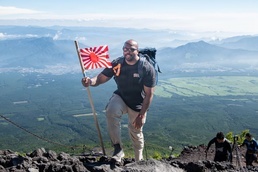
Shizuoka, JAPAN (July 25, 2026) – Naval Air Facility (NAF) Atsugi was quiet and still as people slowly shuffled through the dark Morale, Welfare, and Recreation (MWR) parking lot. Carrying gear and rubbing their tired eyes they slowly boarded the idling bus in the corner of the lot. Once everyone was aboard the bus driver closed the door promptly at 3 a.m. and drove down the empty streets towards the Main Gate. Next stop: Mt. Fuji.
The 25 participants were beginning the Mt. Fuji Summit Climb tour, hosted by MWR Atsugi’s International Tours & Travel (ITT) office. As the bus traveled to the mountain, the tour guide gave a safety brief to the participants on board.
“How many people have climbed Mt. Fuji before?” one of the tour guides asked the group of sleepy passengers.
The passengers glanced around the bus. No hands were raised. For everyone aboard, it was a first attempt at climbing Japan’s most iconic landmark. A sense of comradery amongst strangers was forming as they realized they were all embarking on the same adventure with little idea of what awaited them.
When the bus arrived at Fuji Subaru Line 5th Station, the mixed group of Sailors, dependents, and civilian employees dismounted into the cool, crisp air. Already above the clouds, the group adjusted to the elevation as they checked their gear and stretched. The feeling of excitement and awe consumed the tour group as they looked up at the peak of the mountain in the distance.
The group set off together at 5:45 a.m., taking in the views as they walked on the easy part of the trail towards the 6th station. The people in the group talked as they walked; morale was high as they discussed what was to come further up the mountain.
At the 6th station the group naturally split apart into smaller units as people settled in with others at a similar pace. As the journey went up the mountain the difficulty of the trail increased, adding more distance between the newly formed units of climbers.
At each resting area the groups would come together again for a brief time. Climbers on the tour would unite at each rest area, sit together on the small wooden benches, chat, make friends, and laugh with each other while sharing water and snacks. Morale was high as the small groups intermingled. Once rested enough to continue, climbers would exchange goodbyes and begin climbing towards the next rest area.
The rest areas became a beacon of hope as the trail got more difficult and the high-altitude drained the climbers’ energy.
“Just need to get to the next one [rest area],” Navy Counselor First Class Glhnathan King kept muttering to no one in particular between exhausted breaths.
After a while each rest area became quieter than the last as the climbers began to lose energy. The playful chatting turned into concerned questions.
“How much further do we have to go?”
“Will I be able to reach the summit?”
“Should we turn around?”
The higher the altitude, the lower the morale. At each new rest area, the climbers arrived sweatier, dirtier, and more mentally broken.
Yeoman 1st Class Dameskarl Espinosa, a sailor assigned to NAF Atsugi’s Administrative Department, limped slowly into the rest area at the 8th station. Exhausted, in pain and out of breath he found his small group of comrades. He looked at them with a thousand-yard stare, and mumbled, “I’m never doing this again.”
Each step up the mountain got shorter as the fatigue built up and the air got thinner. The combination between steep terrain and thin air began to take its toll. No one could wait for rest areas anymore, a break every few meters was now required. After 6 hours of climbing the peak was visible but seemed to never get any closer.
After the 9th station, the final safe haven before the summit, the climbers looked up the steep slope towards the summit with dread. The once exciting adventure had turned into an agonizing battle of mental and physical strength.
The pace from the 9th station became a crawl. People bunched up on the thin and steep trail. This final stretch of trail became a single line made of one continuous mass of broken people. Along the trail were people lying on the sharp rocks, covering their heads with whatever was available to block the sun in a desperate attempt to fight the altitude sickness. Those still able to stand walked over the ill and kept moving.
Eventually each of the climbers stumbled up the final set of stairs and stepped through the Torii gate marking the end of the ascent.
The views from the top, and the pride that came with completing such a demanding challenge made every painful step worthwhile.
“I am glad I did it this one time,” said Espinosa. “It was very difficult, but I am extremely happy to have had the experience and completing the challenge.”
While each participant experienced the climb a bit differently, they all shared a sense of accomplishment after reaching the summit.
“This was a true test of my mental fortitude,” said King. “This was the best and worst experience of my life, but I am so glad that I got to take part in something so special.”
For many of the participants, the climb was more then reaching Japan’s highest peak, it was a reminder that some of the most rewarding experiences come from pushing beyond what once seemed impossible.
As the bus made its way back to NAF Atsugi that evening, the tired group returned with sore legs, sunburned faces, and a shared accomplishment – completing an unforgettable adventure together.
The Mt. Fuji Summit Climb is one of the many trips offered through MWR Atsugi’s ITT office, giving members of the community the opportunity to explore Japan in a variety of ways.
NAF Atsugi supports the combat readiness of Commander, Fleet Air Western Pacific, Commander, Carrier Air Wing FIVE (CVW) 5, Helicopter Maritime Strike Squadron (HSM) 51 and 23 other tenant commands, and provides logistic support, coordination, and services to units assigned to the Western Pacific.