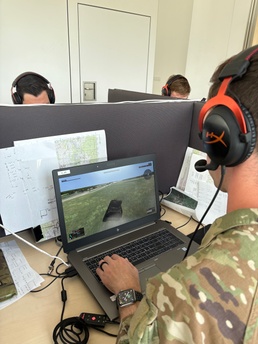
FORT LEAVENWORTH, Kan. — Drone warfare in Ukraine is fundamentally changing modern combat. To prepare American troops for these rapidly evolving tactics, the U.S. Army has launched a virtual reality training program called the Virtual Drone Collective Trainer. Built as a downloadable software plugin, the Virtual Drone Collective Trainer, or VDCT, helps whole units practice fighting alongside friendly drones while defending against hostile robotic swarms. According to Robert Schutz, deputy of the Combined Arms Command-Training Innovation Facility building the plugin in-house gave the Army unprecedented speed. "We didn't have to go back to the vendor and ask them to make something," Schutz said. "We were able to do it on our own. We do two-week sprint cycles... We can usually crank out a new capability in two to three weeks and put it right back on the portal so it's immediately available." Unlike basic flight simulators that only teach individual steering, the training facility designed VDCT as a cognitive trainer. Program documents note that it forces leaders to make high-stakes tactical choices under fire, such as managing drone battery life, choosing sensor packages and reacting to surprise aerial attacks. "The tool doesn't do the teaching," said Hans Hull, a Virtual Battle Space programmer. "The tool just provides you with the chessboard to do your training, but you still have to have leaders to lead the training... Without leaders, we’re just hanging out." The program runs on the Army's existing Games for Training network, which connects thousands of laptops across 78 worldwide bases. Because it uses standard hardware, local instructors can easily build custom missions, tweak drone speeds and simulate artificial intelligence-controlled enemy drone swarms. Hull highlighted that VDCT allows units to tailor aircraft specs to match real-world operational needs. "They can change the characteristics of the drones to match the kind of drone that the unit might be using for real in the field," Hull said. "They can give it better top speed, a slower top speed, make it fly farther... give it better endurance or restrict it, and they can also observe with them and put weapons on them." To bridge the gap between simulation and reality, soldiers can plug real combat controllers and virtual reality headsets directly into their laptops. Military developers emphasize that this hands-on setup helps operators build proper muscle memory before moving to expensive live-fire exercises. The system's true power lies in its ability to scale across an entire formation. During a recent large-scale exercise at Fort Cavazos, Texas, the Army networked 145 laptops together. This allowed simulated drone threats to pop up directly on real-world military Mission Command Information Systems, creating a massive, connected battlefield for battalion and brigade staffs. "Our team spent quite a bit of development time optimizing the VDCT software so it will run on older hardware," Schutz said. "You don't have to have the newest, fanciest laptop... We made a very conscious decision up front that we wanted this capability to go to all of the users." As the program looks toward next-generation capabilities, the Army is executing a phased rollout to transition its core training software to the VBS4 platform, which introduces realistic graphics, smarter AI, and smoother performance for large scenarios. Unlike older platforms, VBS4 removes geographical boundaries. "With VBS3, the terrain was a small patchwork," Hull explained. "With VBS4, it's the whole Earth. You have the entire globe to work with." Concurrently, the Army plans to leverage the Reconfigurable Academic and Adaptive Digital training environment to bridge the gap between legacy simulators and future tactical drone platforms. According to program plans, the primary intent of RAAD is to simulate any advanced drone or payload in any environment against any threat. This includes training operators on the "one-to-many" control of autonomous drone swarms while stimulating Common Operational Pictures for high-level command visualization and battlespace management. Developers are actively working to ensure that both VDCT and these advanced RAAD drone tactics transition smoothly into the military's future Synthetic Training Environment framework, ensuring U.S. soldiers maintain their technological edge.