Using the Department of War’s Middle Tier of Acquisition Rapid Prototype (MTA-RP) approach and an Other Transaction Authority (OTA) contract, the Air Combat Electronics Program Office (PMA-209) was able to design and verify a fully integrated system in three years then award the production contract in months versus years. By focusing on warfighters’ needs, PMA-209 continues to deliver cutting-edge capability while embracing creative acquisition and delivery practices.
This speed to the fleet approach gave PMA-209’s Digital Interoperability Marine Air Ground Task Force (MAGTF) Agile Network Gateway Link (DI MANGL) team the ability to award the OTA to Kranze Technology Solutions, Inc, three months from being cleared for production. The Firm Fixed Price OTA consists of a base plus four one-year options for a total of 113 DI MANGL kits. In the first year, six kits are designated to the MV-22B Osprey.
To address the essential communications gap within the MAGTF, DI MANGL started as a Universal Urgent Need Statement (UUNS) solution. The UUNS system enables users across disparate networks to share information that was once stove piped. The physical challenge of the UUNS system is that it is designed to fit on a pallet taking valuable troop seating when installed.
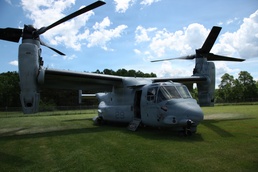
Transitioning the UUNS solution away from the pallet design to a fully integrated system was accomplished by implementing the MTA-RP acquisition pathway. Upon successful installation and demonstration of MTA-RP exit criteria the program transitioned to a Major Capability Acquisition (MCA), Acquisition Category II (ACT II) program entering at Milestone C in April 2026. The demonstration vehicle was an MV-22B Osprey and testing was complete in just under four months.
The dual pathway approach allows programs like PMA-209 to use the traditional MCA model for hardware, while concurrently transitioning the software development components of the system to the specialized Software Acquisition Pathway (SWP) post-Milestone C.
PMA-209’s DI MANGL was one of the first programs to execute the MTA-RP pathway and is now one of the first programs working a dual pathway to include a SWP. The goal is to establish a continuous authority to operate which maintains cybersecurity compliance, improves capability and maximizes operational performance with 3-to-6-month continuous software cycle updates.
“We’re not just improving existing systems—we’re building a new category of capability that challenges traditional frameworks and redefines what’s possible at the tactical edge,” stated Capt. Robert Smith, PMA-209 program manager. “We are using the flexibility of the MTA and an innovative approach to product development to deliver an effective technical solution to better meet the needs of the Marine Corps.”
DI MANGL links disparate tactical networks (air-to-air, air-to-ground, sensor data, and satellite communications) through intelligent gateways for seamless data sharing. This revolutionizing digital integration between legacy and modern tactical networks is essential for fleet readiness across the Marine Corps battlespace. The DI MANGL program of record includes outfitting MV-22B, KC-130J and CH-53K aircraft.
PMA-209 delivers current and future, common and protected, foundational capabilities and standards that ensure naval aviation forces win in combat and is Naval Air Systems Command's executive agent for the development and management of cutting-edge air combat electronics systems.