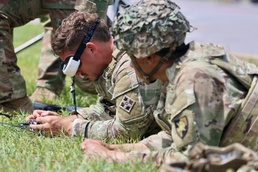
FORT RUCKER, Ala. — The Unmanned Advanced Lethality Course is pushing forward with a series of updates aimed at strengthening tactical proficiency and meeting student expectations, according to Staff Sgt. Mario Rostran, the course's noncommissioned officer in charge, and Chief Warrant Officer 3 Robert Gatta, the course manager.
Rostran said the cadre is focused on refining instruction based on student feedback to ensure the course delivers the advanced-level rigor it promises.
“We’re continuing to improve the course,” Rostran said. “We’re taking comments as we go and making sure we’re meeting the standards students expect. The goal is to make this the advanced course it claims to be.” Working alongside the cadre, Gatta is helping expand hands-on training and strengthen tactical application throughout the program.
"The most significant update is increasing the amount of physical, kinetic engagements from 5 to 12," Gatta said. "We have been working to refine the overall course to run smoother and provide the most up-to-date data."
To meet the demand for advanced instruction requested by both students and the Army, the course is shifting to a more tactical framework. Gatta noted that this week, the class will complete a culminating exercise (CULEX) at the drone training facility in Daleville, marking a brand-new experience for the students.
"This exercise will demonstrate a more real-world tactical environment and incorporate a Close-Quarters Battle (CQB) level of training, whereas previous emphasis has been heavily placed on outdoor live flights," Gatta explained. "Our current goal is to make the training more tactical in nature. I believe we have several solid plans to build on moving forward."
Working alongside the cadre, Gatta is helping expand hands-on training and strengthen tactical application throughout the program.
During this iteration of the course, students conducted live-engagement training using a purpose-built attributable system, the Shank 1.0, and C4, a versatile plastic explosive. The event allowed students to apply lessons learned by flying the system, coordinating altitude and executing tactical employment against a designated target.
Sgt. 1st Class Riley Watts of Company A, 1st Battalion, 14th Aviation Regiment, spent months trying to enroll. He said attending the course has given him a clearer view of how unmanned aircraft systems fit into the future of Army aviation. Watts said that the hands-on training and exposure to emerging capabilities reinforce why the course matters.
“This is a great course to keep you relevant in today’s force,” Watts said. “Seeing how UAS is being implemented and utilized in today’s Army is eye opening, and it shows you how important it is to understand these systems.”
West Point Cadet Matthew Baldwin, a rising sophomore and civil engineering major from Andover, Kansas, is attending the course to take tactical drone employment strategies back to the U.S. Military Academy's Future Applied Systems and Tactics team. He said his leadership pushed to send two cadets to the course to expand their understanding of drone employment and share that knowledge with the Corps of Cadets.
Baldwin, who hopes to branch into Air Defense Artillery, said the course offers a perspective that will matter for future Army operations.
“If I’m lucky enough to branch ADA, one of the big questions is how to counter drones effectively,” Baldwin said. “You’re talking about sending a very expensive rocket to take out a cheap drone. Understanding drones from the operator’s side, how they fly, what they look for, helps you understand how to counter them.”
Though he arrived with limited tactical flying experience, Baldwin said the hands-on instruction has boosted his confidence significantly.
“I didn’t know how to tactically fly. It’s a completely different flying style,” he said. “I feel better flying them, and now we’re trying to develop a training program to help build other pilots on our team.”
Beyond flying, Baldwin highlighted the value of the course's mission-planning segments.
“I’ve really appreciated the planning side, MDMP, troop leading procedures, what goes into reconnaissance,” he said. “I hadn’t learned a lot of that yet. Going into my MS200 class and eventually into the Army, my knowledge base is definitely better now.”
The UALC runs six times per fiscal year, providing recurring opportunities for soldiers seeking advanced UAS training. Prospective attendees should coordinate with Gatta for scheduling and enrollment. Upcoming course dates include Sept. 14-Oct. 2, and Nov. 2-20.