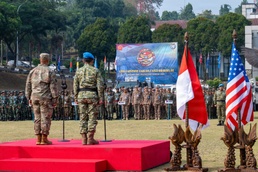
SENTUL, Indonesia - The Hawaiʻi National Guard participated alongside military members and civilians from 22 nations during the opening ceremony of the final Global Peace Operations Initiative (GPOI)-funded Exercise Garuda Canti Dharma (GCD) III on July 20 at the Indonesian Peacekeeping Training Center, where more than 700 participants gathered to enhance multinational peacekeeping capabilities.
This year's iteration marks the closing chapter of more than two decades of GPOI support while taking place during the milestone 20th year of Hawaiʻi's relationship with Indonesia through the National Guard State Partnership Program (SPP), a bond that continues to grow through shared training, trust and cooperation.
Serving as a keynote speaker during the opening ceremony, Brig. Gen. Phillip L. Mallory, Hawaiʻi National Guard deputy adjutant general, reaffirmed the enduring relationship between Hawaiʻi and Indonesia and the importance of continued multinational cooperation.
“Garuda Canti Dharma has become one of the world's premier multinational peacekeeping exercises,” Mallory said during his opening remarks. “The participation of military professionals from so many nations reflects our shared commitment to preparing peacekeepers who are ready to serve with professionalism, integrity and respect for the people they are entrusted to protect. Training together today strengthens our ability to operate together tomorrow in support of international peace and security.”
Since becoming SPP partners in 2006, Hawaiʻi and Indonesia have steadily expanded cooperation in disaster response, aviation, cyber defense, medical readiness, reserve force development, operational planning and professional military education.
As island and archipelagic communities, both share many of the same challenges, from disaster response and maritime security to protecting critical infrastructure. Those common experiences have transformed a military relationship into an enduring friendship built on trust, shared expertise and mutual respect.
Jointly hosted by U.S. Pacific Command and the Tentara Nasional Indonesia, GCD III is the world's largest annual multinational peacekeeping field training exercise. Held July 20 through Aug. 2 at the Indonesian Peacekeeping Training Center in Bogor, West Java, the event promotes global peace and security by bringing together partner nations to train in realistic multinational peacekeeping operations.
Designed to prepare military personnel for future United Nations peacekeeping missions, GCD III combines staff planning, classroom instruction and realistic field training. Participants develop interoperability while improving their ability to operate effectively in complex multinational environments.
Coinciding with those efforts, the Major Defense Cooperation Partnership (MDCP) - signed by the United States and Indonesia on April 13, 2026, provides a framework for expanded cooperation in military modernization and capacity building, training, professional military education, exercises and operational cooperation.
Planning for GCD III relied on two Hawaiʻi Army National Guard field grade officers assigned to the Exercise Support Group, who synchronized personnel, logistics and operational requirements alongside U.S. Pacific Command planners and multinational partners.
Leading the Exercise Support Group's administrative and logistics planning, Maj. Irish Manayan coordinated personnel, resources and multinational support requirements. Maj. Randall Duldulao directed operational planning efforts, integrating participating forces into a unified multinational training environment while coordinating activities across multiple organizations.
“It was an honor and privilege to help plan and execute Garuda Canti Dharma III,” Duldulao said. “Although each nation brings its own processes, we all share the same mission. Exercises like this build the trust and understanding needed to succeed together.”
Reflecting nearly two decades of collaboration through the SPP, GCD III highlights the trust and cooperation that continue to connect Hawaiʻi and Indonesia beyond the annual exercise.
“Garuda Canti Dharma III represents the culmination of a highly successful program, and Indonesia has the honor of hosting the final multinational peacekeeping exercise under GPOI,” said Maj. Karen DeLoria, director of ground capabilities development for the U.S. Military Group at U.S. Embassy Jakarta, Indonesia. “The Hawaiʻi National Guard has been instrumental to that success, consistently providing U.S. forces and expertise that have helped sustain this long-standing effort while reinforcing our enduring relationship with Indonesia.”
In addition to planning responsibilities, Hawaiʻi Soldiers are serving as instructors, subject matter experts and participants across multiple training events. Five Soldiers from medical units support two medical training lanes, while Soldiers assigned to the 1st Squadron, 299th Cavalry Regiment provide two instructors and 10 Soldiers for the field training exercise.
Working alongside members of the Republic of Fiji Military Forces, Soldiers from the 299th Cavalry Regiment form a multinational peacekeeping platoon, training in patrol operations, checkpoint procedures, casualty care and other peacekeeping tasks designed to improve tactical proficiency and interoperability.
Altogether, 19 Hawaii ARNG Soldiers are supporting Garuda Canti Dharma III through planning, medical support, instruction and field training.
Training throughout the event included patrol operations, checkpoint management, first aid, crowd control and explosive ordnance disposal, as well as a multinational Gender Focal Point course designed to support the meaningful participation of women in international peace operations.
After the opening ceremony, Mallory met with Maj. Gen. Iwan Bambang S., S.I.P., commander of the Indonesian Armed Forces Peacekeeping Center, to reaffirm the importance of continued cooperation through the SPP and discuss opportunities to build upon more than two decades of peacekeeping collaboration following the conclusion of GPOI.
Another key engagement included Brig. Gen. Hengki of Indonesia's Ministry of Defense National Reserve Agency, known as Badan Cadangan Nasional, or BACADNAS, where discussions focused on future collaboration in reserve force development, which supports the MDCP.
Meetings with members of the U.S. Embassy country team also provided updates on U.S. defense cooperation priorities in Indonesia while identifying opportunities to expand future bilateral engagements.
Collectively, those engagements showcased Hawaiʻi's broader role in supporting Indonesia's long-term defense development. Through recurring SPP exchanges, personnel continue to share expertise in operational planning, cyber modernization, aviation, rotary-wing operations, air refueling, explosive ordnance disposal, medical readiness and professional military education.
This year's exercise also marks the final iteration funded through GPOI, a U.S. Department of State security assistance program that helped Indonesia build one of the world's premier multinational peacekeeping exercises over more than two decades.
Although this exercise concludes the chapter supported by GPOI, the relationships forged over more than two decades continue under the SPP and the MDCP.
“Looking ahead, the Hawaii National Guard is excited to continue building on this partnership through future exchanges and engagements,” Mallory said. “We also look forward to integrating capabilities such as our Chemical, Biological, Radiological, Nuclear, Explosives Enhanced Response Force Package and Civil Support Team. Just as importantly, we learn as much from our partner nations as they learn from us.”
While Garuda Canti Dharma III concludes the chapter supported by GPOI, it also marks the beginning of the next chapter in Hawaiʻi's long-standing friendship with Indonesia. Over the past two decades, that friendship has grown through trust, shared expertise and mutual respect. As it continues to evolve, both partners remain committed to meeting future challenges together.