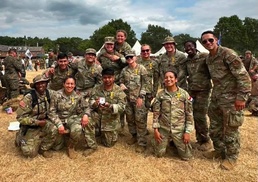
NIJMEGEN, Netherlands– Testing their physical endurance, mental resilience, and teamwork, Soldiers from Landstuhl Regional Medical Center joined thousands of military personnel and civilians from around the world in the historic International Four Days Marches in Nijmegen, Netherlands.
The 108th annual Nijmegen Four Days Marches, known as the "Walk of the World," took place July 21-24, with more than 47,000 participants, including over 6,500 service members from 77 different countries. Participants marched 100 miles (160 kilometers) over four consecutive days. Military participants completed the event in uniform while carrying a standard-issue 22-pound (10-kilogram) rucksack.
Established in 1909 to promote military fitness, the event has evolved into one of the world’s largest walking events and a symbol of international friendship and military cooperation. The route passes numerous World War II battlefields and memorials, allowing participants to honor the sacrifices of Allied service members while strengthening relationships among NATO and partner nations.
Today, participants ranging in age from 11 to more than 90 travel to the Dutch city on the Waal River with a single objective: earning the coveted Vierdaagsekruis, or Nijmegen Cross. This year also marked 80 years of support from the Dutch Red Cross.
Earning the medal requires months of preparation.
Sgt. Banegas Matute, a licensed vocational nurse at LRMC, noted that the team spent six months getting ready for the grueling 100-mile trek.
“We conducted bi-weekly ruck marches, progressively increasing our mileage to build endurance and improve our ability to carry weight over long distances,” said Matute.
1st Lt. Gracious Asantewaa, chief army health clinics support cell at LRMC, said the training was not just about being physically prepared, but developing the mental fortitude to endure discomfort, exhaustion, and the monotony of walking long miles every day.
“Our preparation included endurance training, strength training and participating in several qualifying ruck marches leading up to this one,” said Asantewaa. “Each event helped us build endurance while identifying areas where we needed to improve.”
Once in the Netherlands, the LRMC team was struck by the overwhelming support from the local communities.
Matute said that while the march was mentally and physically demanding, the festive environment created by the Dutch spectators cheering loudly and blaring music at the starting line was unforgettable.
“The energy in the towns was incredible,” Matute said. “The children were giving us high-fives and handing out treats, while families cheered us on with music and encouragement. Every town celebrates marchers, and that support keeps you going.”
For Asantewaa, the camaraderie was the most memorable part of the experience.
“This is my third time participating in Nijmegen and every year I leave with an even greater appreciation for the friendships and partnerships built through this event,” Asantewaa said. “Walking shoulder to shoulder with our NATO allies and partner nations reminds me that despite our different languages, cultures and uniforms, we all share the same values; service, sacrifices, professionalism, and respect for one another.”
The greatest test came on the third day as participants crossed the hilly landscape around Groesbeek. Known as one of the most punishing legs of the journey, the route takes marchers through the infamous "Seven Hills" (Zevenheuvelenweg), pushing participants up steep climbs while they battle fatigue and painful blisters.
“There were times when my body wanted to stop, but my teammates kept me going,” Asantewaa said. “Sometimes all it takes is someone beside you saying , ‘We’ve got this’ and suddenly you find the strength to keep moving.”
The LRMC team had a distinct tactical advantage.
“Our medical training was a major advantage because we could recognize potential hot spots and treat blisters early before they became a serious issue,” said Matute. “We still experienced the normal wear-and-tear, but our background knowledge helped keep minor injuries from turning into something much worse.”
The team also relied heavily on one another throughout the march.
“We stayed motivated by talking, laughing and playing music,” Matute said. “We made sure everyone maintained a pace we were comfortable with for the group.”
LRMC Soldiers successfully completed the four-day march and earned the prestigious Vierdaagsekruis(Nijmegen Cross), an officially recognized foreign military decoration.
For the Soldiers, the accomplishment represented more than completing a physically demanding event. “This achievement demonstrates that even though we serve in a hospital environment, we remain physically resilient and ready to perform under demanding conditions,” Matute said. It reflects the discipline and readiness expected of every Soldier.
Marching alongside service members from allied nations also reinforced LRMC’s mission of supporting multinational military operations.
"It was an absolute honor to participate in this historic event,” said Lt. Col Chariti Paden, chief patient administration division at LRMC. “I truly believe that the intense mental and physical endurance required to finish this march will directly translate into greater resilience and deeper empathy in the care we provide our patients."
Asantewaa said the lessons learned during the event extend well beyond the finish line;preparation is essential, and teamwork is critical.
“Events like this test our grit and strengthen our teams,” Paden said. “When our medical professionals overcome challenges together outside the hospital, it builds trust, resilience and teamwork that carries directly into patient care. Stronger teams ultimately provide better care for our service members, families and allies.”
Capt. Caroline Kyalo, intensive care unit officer in charge at LRMC said the team overcame minor injuries and finished the demanding four-day event together, exemplifying resilience, commitment, teamwork and Army values.