MANILA, Philippines – “I shall return,” U.S. Army Gen. Douglas MacArthur declared after departing Corregidor for Australia under orders from President Franklin D. Roosevelt in 1942. Command of the island then passed to Gen. Johnathan Wainright, whose forces continued the defense of Corregidor until its surrender on May 6, 1942. Together, the determined defense of Bataan and Corregidor delayed the Imperial Japanese advance by more than 100 days, buying valuable time for Allied forces across the Pacific.
More than 80 years later, Marines and Sailors withMarine Rotational Force – Southeast Asia, I Marine Expeditionary Force, retraced that history during a staff ride to Corregidor on July 25, 2026. The visit served as a professional military education staff ride, allowing Marines and Sailors to study the decisions, leadership, and hardships of the Battle of Corregidor on the ground where history unfolded.
“A staff ride is not a battlefield tour,” said Col. Robert S. Bunn, commanding officer, MRF-SEA, I MEF. “The intent of a staff ride is to challenge Marines and Sailors to study the decisions leaders faced, understand the human cost of combat, and think critically about how those lessons apply to the missions we execute today alongside our Philippine Allies. Corregidor reminds us that the strength of our historical alliance is forged through shared sacrifice and that sacrifice, even in momentary defeat, can have strategic consequences that set conditions for ultimate victory. We are reminded that the delay at Corregidor, ultimately falling in May 1942, likely contributed to the near-run success at Guadalcanal only a few months later.”
During the drive from Manila to the Bataan Peninsula, Marines and Sailors discussed the operational decisions that shaped the defense of Corregidor and Bataan.Team leaders examined how the defenders adapted under increasingly desperate conditions, from modifying artillery ammunition for counter-battery fires to aviators joining the island’s ground defense after losing their aircraft. The discussion emphasized not only what happened, but why leaders made the decisions they did and how those lessons remain relevant to today’s operating environment.
A short voyage aboard a traditional Philippine banka carried the group across the final stretch of water to Corregidor. Upon arrival, the Marines and Sailors toured several of the island’s most significant sites, including Battery Way, The Mile-Long Barracks, Malinta Tunnel, and the Pacific War Memorial.
At Battery Way, the group examined four 12-inch mortars that remain in their original firing positions. Built to engage hostile warships with plunging fire, the weapons illustrate both the engineering and determination that characterized the island's defense. Nearby underground magazines protected ammunition beneath reinforced concrete and steel, allowing the batteries to continue fighting despite relentless bombardment.
“As an artilleryman, it was inspiring to see wheremy predecessors lived and operated massive artillery pieces,” reflectedCapt. Remington Mederos, an artillery officer and joint terminal attack controller with Air-Naval Gunfire Liaison Company Detachment-North, MRF-SEA. “Being able to see the structures and the devastation wrought by two separate invasions of the island gave me a good look into life on Corregidor during the war and the reality of defending it.”
The group continued to the Mile-Long Barracks, once home to thousands of U.S. service members stationed on the island. Although never actually a mile long, the structure remains one of Corregidor’s most recognizable landmarks. Scarred by aerial bombardment and reclaimed by the surrounding jungle, the ruins stand as a reminder of the intensity of the battle fought here.
Inside Malinta Tunnel, Marine and Sailors experienced the cramped headquarters where MacArthur directed the defense of the Philippines before departing for Australia. The tunnel also housed a 1,000-bed hospital staffed by Army and Navy nurses – later remembered as the Angels of Bataan and Corregidor – who continued treating casualties despite dwindling supplies and constant attacks.
“The courage, dedication, and resilience of the nurses to continue care until the very last moment of the assault should set the example for all military medical personnel,” said Navy Petty Officer 3rd class Devin Avila, a corpsman with MRF-SEA. “After seeing the tight, cramped tunnelswhere the hospital operated and knowing supplies were scarce, they still kept patients alive, and that is a standard I aim to achieve as a corpsman.”
For 1st Lt. Patrick Matsko, MRF-SEA's manpower officer, the experience reinforced that leadership extends beyond tactics.
“History isn’t just something we study – it's something we learn from,” said Matsko. “Standing where American and Filipino service members made impossible decisions under unimaginable conditions puts leadership into perspective. As Marines, we’re expected to make sound decisions under pressure, and staff rides like this challenge us to think critically about how we lead, prepare our Marines, and accomplish the mission when circumstances change.”
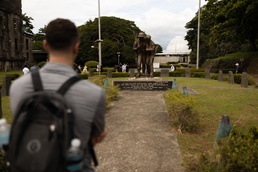
The final stop was the Pacific War Memorial, where an eternal flame overlooks the island in honor of those who defended Corregidor. Nearby, a mausoleum commemorates the American and Filipino service members who fought and died during the campaign. Designed so that each year on May 6, the anniversary of Corregidor’s surrender, a beam of sunlight shines directly through the memorial onto the altar below, the site stands as a lasting tribute to their sacrifice.
For the Marines and Sailors of MRF-SEA, the staff ride was more than a visit to a historic battlefield. It provided an opportunity to study leadership under extreme adversity, reflect on the cost of war, and better understand the alliance they continue to strengthen alongside the Armed Forces of the Philippines. More than eight decades after the Battle of Corregidor, the lessons learned there continue to shape the leaders responsible for preparing today’s force to meet tomorrow’s challenges.
Inscribed on a statue outside of the memorial are words honoring those who defended the island:
“Brothers in arms. In these hallowed surroundings where heroes sleep, may their ashes scatter with the wind and live in the hearts of those who were left behind. They died for freedom’s right and in heaven’s sight, theirs was a noble cause.”