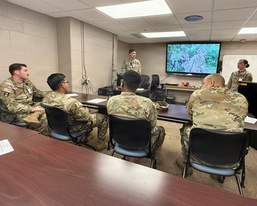
FORT LEAVENWORTH, Kansas — Munson Army Health Center Soldiers who tested their medical skills in realistic battlefield conditions earlier this summer are now passing those lessons to others across the organization.
The Soldiers led a leader professional development session July 23, detailing their participation in the Joint Emergency Medicine Exercise, or JEMX, conducted this past June at Fort Hood, Texas.
Supported by III Armored Corps and Carl R. Darnall Army Medical Center, the annual exercise brings together military medical professionals from different specialties, services and partner nations. Participants train in scenario-driven environments designed to help bridge the gap between healthcare delivered in a military treatment facility and care provided under austere operational conditions.
During the LPD, the Munson team discussed how the exercise challenged them to apply their clinical knowledge while adapting to limited supplies, delayed medical evacuation, environmental threats and the competing demands of patient care and battlefield security.
Training included Tactical Combat Casualty Care, prolonged field care, patient movement, Role 1 (unit care) and Role 2 (forward medical unit) medical support, medical evacuation, casualty evacuation, care under fire, chemical, biological, radiological and nuclear casualty care, walking blood bank procedures and treatment of military working dogs.
For Sgt. Joseph Smith, a 68W, or combat medic specialist, one of the most valuable aspects of the exercise was working alongside physicians, nurses, ancillary medical specialists and international partners.
“Interacting with all those doctors was unlike anything else I’ve experienced,” Smith said. “It was probably some of the most organized and well-put-together training I’ve attended.”
Participants were deliberately placed in unfamiliar roles and rotated through leadership positions. A nurse might be directed to lead a treatment team, while a physician accustomed to providing care might be assigned responsibility for coordinating personnel and making broader operational decisions.
The approach required participants to communicate across specialties, trust the expertise of others and make decisions outside their normal areas of responsibility.
One Munson practical nursing specialist described working in a simulated Role 1 environment as casualties arrived following mock indirect-fire attacks. The medical team had to triage patients, provide treatment and prepare them for evacuation while maintaining light and noise discipline and watching for simulated threats.
Medical personnel improvised when standard equipment was unavailable, using paracord to hang blood products, headlamps to provide care in darkness and locally available materials to monitor patient output. Cadre also restricted supplies and delayed resupply to force participants to determine how they would continue caring for casualties when resources became scarce.
“The thing I took away was the critical thinking,” said Sgt. Milton Cadiz, a 68C, or practical nursing specialist. “How do I assess a casualty in a time of stress with everything else going on? What do I see first, and what do I treat first?”
The training also highlighted the importance of prolonged field care.
“In future operational environments, medical personnel may need to sustain a casualty for an extended period before evacuation to a higher level of care is available,” explained Cadiz.
Participants practiced establishing a walking blood bank, providing field-expedient care and tracking patients over time.
Other training exposed the Soldiers to procedures and capabilities not normally encountered during their daily duties at an outpatient military treatment facility.
The diverse Munson team brought different perspectives to each scenario. Combat medics shared their experience organizing aid bags and providing point-of-injury care, while preventive medicine personnel evaluated sanitation, waste control, water sources, environmental hazards and the potential for disease and nonbattle injuries.
Those discussions demonstrated that battlefield medicine depends on more than emergency treatment alone. Preventive medicine, logistics, patient administration, behavioral health and other supporting specialties contribute to sustaining the force and preventing additional casualties.
Bringing those lessons home extended the value of the exercise beyond the Soldiers who attended. During the LPD, Munson personnel asked questions about evacuation timelines, field sanitation, medical logistics, casualty tracking, CBRN operations and the roles different occupational specialties would fill in a deployed medical unit.
The exchange helped other members of the formation better understand how their garrison skills translate to operational medicine and identified specialties that could benefit from participating in future iterations of the exercise.
Smith said the experience increased his confidence as a combat medic. The team unanimously recommended that Munson continue sending Soldiers to the exercise and maintain a mixture of clinical and ancillary specialties within future groups.
Munson leaders also encouraged Soldiers to volunteer for similar opportunities and bring what they learn back to the organization.
“You’re not going to be in a military treatment facility forever,” Munson Medical Company Commander Capt. Nichalas Snyder, told attendees. “Go out, learn things and challenge yourself. You may find something you love or something you can bring back to the organization.”
By converting their experiences into professional development for others, the Soldiers multiplied the value of the exercise. Their lessons strengthened shared understanding across the formation, reinforced the connection between garrison healthcare and operational medicine, and helped prepare Munson personnel to support the Army wherever they may be called to serve.