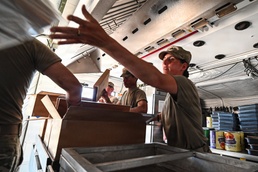
FORT HUNTER LIGGETT, Calif. — While Soldiers across Operation Bold Eagle 26 focused on training, security and medical readiness, one team began its mission long before sunrise, ensuring every Soldier and patient has the nutrition needed to perform at their best.
Army Reserve Nutrition Care Specialists, also known as Military Occupational Specialty, or MOS, 68Ms, assigned to the 325th Field Hospital out of Independence, Missouri, were serving a dual mission during annual training at Fort Hunter Liggett: preparing thousands of nutritious meals for Soldiers across the field environment while simultaneously providing clinical nutrition support to patients inside the field hospital.
While the title emphasizes nutrition, the specialty encompasses far more than meal planning, including clinical care, patient education and support for military medical operations.
"People think that we're glorified cooks," said Staff Sgt. Max Wright, a nutrition care specialist with the 325th Field Hospital. "Yes, we attend culinary training, but our primary mission is nutrition. We work directly with dietitians, support patient recovery, and in field environments we also provide the feeding mission that keeps Soldiers ready to fight."
That balance between field feeding and clinical care is what makes the specialty unique.
Capt. Sara Crews, the unit dietitian, explained that every patient admitted to the field hospital is screened for nutritional risk within 24 hours. Depending on their injuries or medical condition, patients may require specialized diets, increased calories, additional protein or more advanced medical nutrition therapy.
"Our 68Ms are fully empowered to provide basic nutrition guidance," Crews said. "If patients require more specialized interventions, such as tube feeding or medical nutrition therapy, that's where I step in. Together, we create a complete clinical nutrition system."
While patient care remains an essential part of the mission, the field feeding operation is often the most visible.
The work begins well before most Soldiers wake up.
Crews report for duty as early as 3:30 a.m. to prepare breakfast, operating containerized kitchens, maintaining sanitation standards, monitoring food temperatures and coordinating every aspect of meal service before chow begins. The process repeats throughout the day to ensure lunch and dinner are delivered on schedule.
Despite the long hours, the impact is immediately visible.
"We had Soldiers come through breakfast telling us we made their day," Crews said. "When you see someone excited about getting eggs, bacon and pancakes after working in the field, it reminds you why the work matters. It builds morale."
At Fort Hunter Liggett, California, where summer temperatures routinely climb into triple digits, nutrition becomes even more critical.
"It's not enough just to drink water," said Sgt. Brittany Kloepfel, a nutrition care specialist with nearly two decades of military service. "Food is fuel. If your body doesn't have the energy it needs, you're much more likely to become a heat casualty. We're constantly asking Soldiers if they've eaten and encouraging them to fuel their bodies."
That education extends beyond the dining facility.
Nutrition care specialists routinely advise Soldiers on hydration, portion control and proper nutrition to prevent heat injuries while also conducting patient assessments for specialized dietary needs, including burn patients, vegetarians, kosher and halal meal requirements, and other medically directed diets.
Operation Bold Eagle provided valuable hands-on experience rarely available during monthly battle assemblies.
"This is actually the first time I've really been able to perform my job," Wright said. "We're operating the containerized kitchen, working in the field hospital, conducting nutrition screenings and seeing the full mission come together."
Serving as a shift leader for the first time during annual training, Pfc. Warren Bennett, a 68M augmented to the 325th FH, said the experience has reinforced the importance of teamwork.
"Everybody's got to eat," Bennett said. "Someone has to do it. We get up early and stay up late so everybody gets a plate."
For Crews, success is not measured solely by the meals served.
"My mission comes down to my people," she said. "Mission accomplishment means empowering my junior Soldiers — giving them opportunities to learn the clinical side of their profession and helping them grow. If my team is successful, then I'm successful."
Whether supporting patients recovering inside the field hospital or serving hot meals that boost morale across the installation, Army Reserve nutrition care specialists continue to demonstrate that readiness begins with proper nutrition.
Their mission may start in the kitchen, but its impact reaches every Soldier they support.