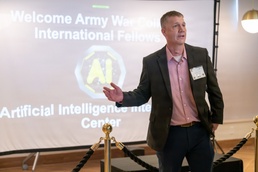
PITTSBURGH — The U.S. Army War College International Fellows Class of 2027 visited the Army Artificial Intelligence Integration Center and Carnegie Mellon University, July 21, as part of its Field Studies Program. During the visit, fellows heard from experts in scientific research, software engineering, information systems, public policy, artificial intelligence and local government. The class includes fellows from 78 partner nations.
Scientific leadership and national power
Cassidy R. Sugimoto, dean of the Marianna Brown Dietrich College of Humanities and Social Sciences, discussed the role of science in national power. She highlighted historical and contemporary contributions to global scientific leadership and stressed the importance of economic resources, human capital and strategic investment in research and development.
Sugimoto also noted the influence of national policy on global scientific leadership and the importance of science diplomacy.
“I hope that I’ve convinced you that science is an instrument of national power, and I hope that you think about that capacity,” she said.
Software engineering and resilience
Paul Nielsen, director and CEO of Carnegie Mellon University’s Software Engineering Institute, spoke about the evolution of software engineering and artificial intelligence. He noted that the institute was established in 1984 to help address software issues in military systems and has since expanded into cybersecurity and AI. Nielsen emphasized trust, resilience and ethics as essential elements in AI development.
“One word that keeps coming up in our business now more than it did originally is the whole idea of resilience,” he said.
He also addressed the challenge of integrating legacy and emerging technologies, emphasizing the need for continuous training and collaboration between military and technical experts.
AI ethics and organizational adaptation
Kirsten Martin, an expert in AI ethics, discussed the future of AI in organizations and the need for new skills and roles during implementation. She said organizations must manage AI carefully to avoid overreliance on automation and the erosion of human expertise.
Martin emphasized that AI should be viewed as an enabling technology, not a replacement for people. “We have to decide to have people in the know in the organization understand the organizational needs enough or better than the AI technology companies, and understand AI just enough in order to know what role it needs to have,” she said.
She concluded that organizations must align AI adoption with mission requirements and institutional values.
Army AI Integration Center (AI2C)
Lt. Col. Dan Weiss, director of the Army Artificial Intelligence Integration Center, discussed the center’s growth since its establishment in 2018. The center has expanded from a 12-person task force to a 175-person organization.
Weiss said the center works with Carnegie Mellon University on AI education programs ranging from data-driven leadership courses to doctoral-level study. He said its priorities include operational support, capability development and research engagement with senior Army leaders.
Recent initiatives include predictive maintenance for aviation, voice-to-text capabilities and large language model applications such as CamoGPT. Weiss emphasized workforce development, talent retention and providing expert guidance to Army leadership.
The visit gave fellows a look at how scientific research, technical innovation and policy shape the responsible use of artificial intelligence in military and civilian settings. Field Studies Program events help broaden the fellows’ understanding of American society, institutions, government and democratic values alongside their military studies.