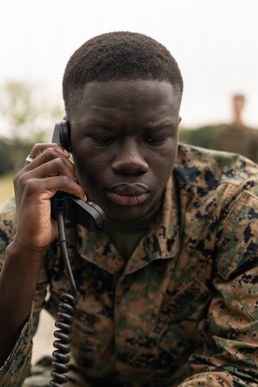
MANILA, Philippines – Spanning approximately 2,000 miles between Manila, Philippines, and Darwin, Australia, communications Marines with Marine Rotational Force – Southeast Asia, I Marine Expeditionary Force, and Marine Rotational Force – Darwin, I MEF, successfully established long-range high frequency communications on July 23, 2026. Using a TRC-209 amplifier paired with an AN/PRC-160 radio, the Marines conducted two-way voice communications that validated their ability to maintaincommand and control across the Indo-Pacific using expeditionary communications capabilities.
"Being able to communicate across 2,000 miles gives us another way to relay information throughout the Pacific Command area of responsibility," said U.S. Marine Corps Sgt. Ulises Garcia-Saucedo, a transmissions system operator with MRF-SEA, I MEF. "It demonstrates our ability to maintain communications from austere locations anywhere in the Philippine archipelago."
Although the communications shot employed a TRC-209 amplifier, Marines can achieve similar long-range communications using just the man-portable AN/PRC-160 radios paired with field-expedient antennas. While the TRC-209 provides increased power output for fixed command posts and combat operations centers, expeditionary Marines can achieve the same long-range HF communications capability.
“A sloping V antenna would allow us to direct oursignal toward Darwin using only a man-portable radio,” said Cpl. Spencer Hozman, a transmissions system operator with MRF-SEA, I MEF. “We’re not dependent on larger equipment like the TRC-209. Communication is an art. Every environment requires a different antenna solution. A sloping V may work in one location, while somewhere else a horizontal dipole is the better choice.”
The successful radio shot demonstrates how forward-deployed Marines maintain command and control while operating across the vast distances of the Indo-Pacific.
The ability to communicate across extended distances using different waveforms is fundamental to how we operate in the Indo-Pacific," said Col. Robert S. Bunn, commanding officer of MRF-SEA, I MEF. "Capabilities like this allow commanders to maintain command and control under varying conditions while enabling Marines to operate from distributed locations. That flexibility is essential to expeditionary operations."
Achieving that level of connectivity depends not only on advanced equipment, but also on the Marines who understand how to employ it in challenging environments. Through routine training and experimentation with multiple antenna configurations, MRF-SEA communicators continue to refine the high frequency capabilities.
“High frequency is one of the most resilient long-haul communication pathways available because it is difficult to detect, locate, and jam,” said Master Sgt. Coty Roberts, communications chief for MRF-SEA, I MEF. “Communicators have relied on HF for decades, and we continue to refine the skills required to employ high frequency communications.”
As Marine Corps forces continue to operate across the Indo-Pacific, long-range HF communications provide a secure and expeditionary means of maintaining connectivity across the region's vast distances and in austere environments. By continually refining these expeditionary communications skills, Marines ensure they remain connected, adaptable, and ready wherever the mission requires.