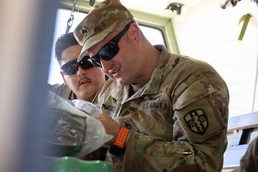
FORT HUNTER LIGGETT, Calif. — When environmental conditions forced the closure of a medical treatment site during Operation Bold Eagle, personnel from the 7416th Troop Medical Clinic in Lubbock, Texas — a subordinate unit of Army Reserve Medical Command headquartered in Pinellas Park, Florida — quickly shifted from a traditional aid station model to a mobile approach that brought medical care directly to Soldiers training across the installation.
The improvised concept, informally dubbed "tailgate medicine" by Soldiers, transformed two Field Litter Ambulances (FLAs) into roaming treatment platforms capable of providing sick call, preventive care and emergency response closer to training areas.
Initially, the medical team operated a fixed aid station supporting units conducting field hospital and brigade-level training. Staffed by 16 medical professionals working around the clock, the aid station treated illnesses, injuries and other medical concerns while determining whether Soldiers could return to duty, required quarters or needed transport to a higher level of care.
When environmental hazards halted operations in the Lacuna training area, leaders quickly adapted.
"We basically took our entire aid station and split it in half," said 1st Lt. Jonathan Bramm, a medical-surgical nurse assigned to the San Antonio-based 7454th Medical Operational Readiness Unit supporting the mission. "We can get out to units that are farther away from an aid station and provide medical care while trying to accomplish the main goal — returning the Soldier to duty."
Each mobile team carried over-the-counter medications, IV fluids, wound care supplies, cooling equipment and diagnostic tools, allowing medics to evaluate and treat many conditions without requiring Soldiers to leave their training areas. Patients requiring additional care could still be transported to the garrison or field troop medical clinics or another higher level of care.
The mobile teams also served as a force multiplier by supporting medics embedded with training units.
"A lot of our medicine that we're providing out here in the tailgate is preventative," said Sgt. Nathan McAleer, a combat medic assigned to the 7210th Medical Support Unit in San Antonio. "We're just helping out those units, those medics that don't have the supplies. We're giving them what they need so they can take care of their people and hopefully not have to transport to the clinics."
Rather than waiting for Soldiers to travel several miles to an aid station, the FLAs continuously patrolled training areas, checking on units, distributing water and electrolyte drinks, responding to medical emergencies and helping prevent heat-related injuries. Brown said the increased presence of medical personnel also boosted morale.
"We're able to get out there, provide Soldiers with Gatorades and ice, cool them down and let them know we care about them," Brown said. "That gets them back in the fight and keeps their morale up."
Leaders overseeing the real-world medical mission believe the concept could have applications beyond this year's exercise. The added mobility enabled providers to respond more quickly to emergencies, support dispersed training units and reinforce medics already operating in the field. While manpower remains the primary limiting factor, leaders said expanding similar mobile capabilities could improve safety and readiness during future large-scale training exercises.
For Brown, however, the success of the mission comes down to the Soldiers making it happen.
"I give all the credit to my team," Brown said. "I've got some really awesome medics, an awesome provider, and they're the ones making this happen. The Soldiers conducting the training are doing a great job, and it's been rewarding to support them while they're out there accomplishing the mission."