Fort Irwin, Calif. – A key highlight of Joint experimentation during Project Convergence Capstone 6 is the Army, Navy and Space Force coming together on the west coast to experiment with the effects of a technology called Hammer of the Gods.
Although Hammer of the Gods is a relatively new technological capability, it has already begun to play an important role in military experimentation. Hammer of the Gods is an emitter that provides an expanded suite of command-and-control (C2) and operational capabilities in a highly deployable, low-electromagnetic-signature, electronic warfare platform, delivering multi-domain effects at the forward edge of operations.
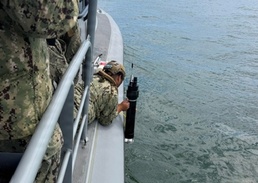
Land-based versions of the system have been featured in various exercises and demonstrations during the past two years, helping warfighters across the joint force explore new ways to operate in the electromagnetic spectrum. More recently, the maritime variant made its debut during PC-C6, marking the first time the technology was tested at sea in mid-July 2026. This milestone represents another step in the system's ongoing development as military leaders continue evaluating how it can enable future operations across multiple domains and enhance Next Generation Command and Control and electronic warfare capabilities.
"Joint experimentation is how we prepare for future fights," said Lt. Col. Darrin Hall, Chief, Modeling, Simulation and Integration (S7/8), U.S. Space Forces Pacific. "By integrating space, cyber and conventional forces into realistic scenarios, we strengthen our ability to operate as one joint team in contested environments."
PC-C6 serves as a critical venue for Army, joint, and multinational allies and partners to integrate and experiment with future warfighting capabilities.
The original plan for Hammer of the Gods was ambitious. Organizers intended to demonstrate both the land and maritime-based versions of the system while supporting learning objectives from the U.S. Army Space and Missile Defense Command and U.S. Space Forces Pacific.
The experiment successfully proceeded with support from U.S. Space Forces Pacific and Naval Base San Diego, enabling the integration of the maritime variant into PC-C6. Their collaboration highlighted the value of joint experimentation, demonstrating how multiple forces can work together across multiple domains to test new electromagnetic spectrum capabilities and gather insights for future operations.
"This experiment proved that counter-PNT capabilities can be deployed, controlled and recovered in real-world maritime operations while extending operational reach through resilient mesh networking. It demonstrates the value of joint collaboration in advancing operational readiness," Hall said.
A key focus of the experiment was understanding Positioning, Navigation, and Timing, a capability that underpins many of today's operations. From helping troops navigate and synchronize communications, to enabling precision-guided systems and supporting uncrewed platforms, reliable PNT information is essential across nearly every domain of modern combat.
"Positioning, Navigation and Timing is the foundation of modern military operations. Understanding how to protect and operate through PNT disruption ensures our forces can continue to shoot, move and communicate effectively," Hall said. "Counter-PNT effects enhances lethality by impacting the backbone for pinpoint targeting via long range artillery, guided missiles, and cruise munitions. Without PNT data, modern weapon precision drops sharply, resulting in delayed missions, missed objectives, or severe collateral damage."
Recent conflicts have highlighted just how dependent military forces have become on these capabilities. When GPS signals or other PNT services are disrupted, the effects can ripple across communications, navigation, and overall mission effectiveness. As a result, leaders are increasingly exploring how forces can continue to operate in environments where these services are degraded or unavailable.
Experiments during PC-C6 provide an opportunity to study those challenges in realistic operational settings. By testing technology like the Hammer of the Gods, commanders can better understand how to shape the electromagnetic environment, improve resilience against PNT disruptions, and refine concepts for operating effectively in contested environments.