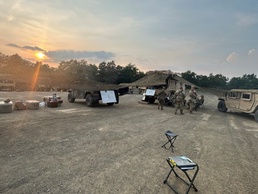
On July 11, 2026, more than 360 Soldiers from the 1092nd Engineer Battalion converged on Camp Dawson in Kingwood, West Virginia, to kick off their Annual Training. Their initial mission: prepare for Large Scale Combat Operations (LSCO) and validate their warfighting capabilities in a simulated peer-to-peer combat environment. However, after large-scale storm caused significant flooding in the state, the entire battalion turned on a dime.
Under the leadership of Lt. Col. Thomas Fish and Command Sgt. Maj. Barry Moore, the formation draws strength from communities across the state, bringing together the 821st Engineer Construction Company (Summersville), 115th Engineer Vertical Construction Company (Clarksburg), 601st Engineer Support Company (Buckhannon), 119th Combat Engineer Company-Infantry (Moundsville), 922nd Utilities Detachment (Martinsburg), 1863rd Field Feeding Platoon (Buckhannon), Headquarters and Headquarters Company (Parkersburg), and the Forward Support Company (Millwood).
Forged in the Field: The Combat Mission Upon arriving at Camp Dawson’s Volkstone Training Area, the battalion established a dispersed Tactical Operations Center (TOC) to reduce their footprint and mitigate the threat of simulated mass-casualty attacks. Over four days, Soldiers honed their warfighting edge, executing weapons qualifications, land navigation, tactical driving, communications, and fighting position installations.
To truly test their mobility and staff battle-tracking, the entire battalion executed a complex "Jump TOC" operation, moving to Pringle Mountain and Camp Branch training areas. There, they immediately transitioned into a force-on-force posture. Using hand tools to carve hasty defensive perimeters out of the earth, the engineers prepared to hold the line.
When simulated hazardous environmental conditions threatened the operation, the battalion staff rapidly executed the military decision-making process. Within three hours, the element successfully jumped back to Camp Dawson. Over the following days, they braved simulated CBRN attacks, indirect fire, and a probing assault by the 119th Sappers, proving their resilience and tactical proficiency.
The Pivot: When the Homefront Calls The National Guard mission is uniquely twofold: defend the nation, and protect the community.
As the 1092nd completed its rigorous combat exercise, alarming weather reports began to surface. A massive storm system was moving through the United States with West Virginia right in its path. Recognizing the danger, battalion leadership immediately developed response courses of action. Twelve hours before the storm made landfall in the Mountain State, the 821st was tasked to redeploy a platoon back to their home armory to refit for Domestic Operations (DOMOPs). This strategic move pre-positioned the battalion’s assets along the I-79 corridor, ready to strike from the north, central, and southwestern regions of West Virginia.
At 20:00 on July 21, the storms hit the state, dumping up to four inches of rain in less than an hour in areas. Rivers breached their banks, severely impacting the Buckhannon and Weston communities.
Immediate Action: Boots on the Ground Governor Patrick Morrisey declared a State of Emergency for all 55 counties and activated the WVNG as the severity of the storm became known.
Under the direction of the WVNG Joint Operations, the 1092nd Battalion sprang into action. The transition from LSCO to emergency DOMOPs was seamless and immediate.
The 115th Engineer Company deployed liaison officers to the Lewis and Upshur County Emergency Operations Center and staged five civilian assistance teams within an hour of the impact zone. By 1:30 a.m., the 821st had pushed Soldiers into Elkins. Before the sun even rose on July 22, the entire 360 - Soldier battalion was moving toward the disaster zones.
Navigating washed-out and destroyed roads, these engineer elements raced to reach citizens in distress. By 12:00 — less than 15 hours after the torrential rains began — the entire 1092nd Engineer Battalion had completely refitted from combat operations and was on the ground supporting West Virginians.
The Impact The results of this rapid response are a testament to the Guard's capability. To date, the West Virginia National Guard, spearheaded by the 1092nd Engineer Battalion, has:
Although the recovery continues, the battalion remains on the line, providing relentless support to the citizens of West Virginia.
This operation showcases the sheer power, agility, and dedication of the 1092nd Engineer Battalion, the 111th Engineer Brigade, and the West Virginia Army National Guard.
“We stand always prepared to execute our federal mission and defend this nation in combat,” said Fish, 1092nd Engineer Battalion Commander. “But when natural disasters strike and local resources are overwhelmed, we are always ready, and always there, to answer the call for our neighbors at home.”