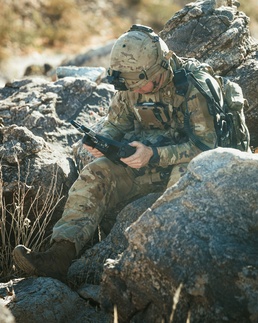
FORT IRWIN, Calif. —The Army continues to experiment with Next Generation Command and Control architecture during Project Convergence Capstone 6, demonstrating current lethality and informing how the Army will extend its command-and-control network capability to additional formations.
At the center of the 10-day experiment at Fort Irwin, California, the 4th Infantry Division is employing NGC2 architecture at the division level under realistic, combat training conditions. The experiment is generating operational feedback that will help shape future modernization efforts while validating the network's ability to connect systems and provide commanders with a shared operational picture that speeds battlefield decisions and synchronizes effects across multiple domains.
“NGC2 is not just a piece of technology, it’s a whole stack approach to command and control - transport, integration, data, and applications” said Maj. Gen. Patrick Ellis, commanding general of the 4th Infantry Division. “PC-C6 has allowed our team to experiment with the entire ecosystem in the unforgiving terrain and harsh climate at Fort Irwin and gather data for Army leaders to inform future decision making on modernization efforts.”
Project Convergence is the Army's premier experimentation event of the year, bringing together joint force components, multinational allies and partners, and industry to evaluate emerging technologies in realistic operational environments before they will be fielded to warfighters across the joint force. Throughout Capstone 6, NGC2 is being assessed alongside more than 90 developing capabilities designed to improve interoperability and accelerate decision-making.
During PC-C6 Soldiers operate transformational technologies while providing immediate operational feedback to industry partners and Army leaders.
By leveraging this feedback through a series of operational events with the 4ID over the past year, the Army recently announced it established an NGC2 common data layer, which enables rapid commercial technology integration throughout the NGC2 ecosystem, such as resilient transport and edge computing technologies, third-party apps, and AI models to rapidly connect commanders with the information they need to make informed decisions.
“The value of NGC2 is getting the right information to the right commander at the right time,” said Lt. Col. Rangel, deputy chief of staff, Command and Control Support Element. “Project Convergence allows us to evaluate how quickly data moves across the network and how that improves commanders’ ability to synchronize effects in a dynamic operational environment.”
The data collected throughout PC-C6 will help shape the continued development of NGC2 as the Army modernizes its command-and-control capabilities for future warfighting operations. The lessons learned during the experiment will help ensure future commanders can sense, decide and act faster across increasingly complex operational environments and make the U.S. Army more lethal.