Preventing the Invisible Threat: Naval Hospital Pensacola Preventive Medicine Technicians Safeguard Fleet Readiness
Brandy Ostanik-Thornton, Naval Hospital Pensacola PAO
PENSACOLA, Fla. — Before a Navy ship can answer the call, whether responding to a humanitarian crisis or supporting military operations halfway around the world, it must first prove it is safe from an often-invisible threat: the spread of disease.
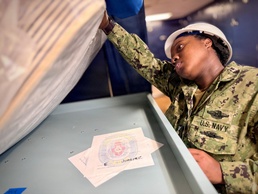
Safeguarding the fleet is a shared responsibility among Preventive Medicine Technicians (PMTs) stationed at medical commands worldwide. Fulfilling their part in this global mission, Naval Medical Readiness Training Command (NMRTC) PRT's serving at Naval Hospital Pensacola's (NHP) Public Health Department recently went aboard the hospital ship USNS Comfort to conduct a routine Ship Sanitation Control Certificate (SSCC) inspection.
While the inspection may appear routine, it represents a critical layer of force health protection that directly supports the Navy’s ability to deploy healthy, mission-ready forces around the globe.
“Our main job is public health and preventing the spread of disease,” said PMT Petty Officer 1st Class Joanna Smith. “The SSCC inspection makes sure there aren’t disease carriers, vectors or other public health risks on board before the ship visits ports around the world.”
Issued every six months, the SSCC is an internationally recognized certification required for ships traveling between ports. The inspection verifies that a vessel does not present a public health hazard by evaluating everything from food service operations and potable water systems to pest management, sanitation practices and medical surveillance.
Because shipboard PMTs cannot inspect their own vessel, independent preventive medicine teams from other commands conduct the assessments, ensuring impartiality and maintaining the integrity of the certification process.
“Without that independent inspection, they aren’t supposed to deploy,” Smith explained. “It ensures an objective look at the ship’s public health program.”
Although USNS Comfort is significantly larger than most facility routine inspections, the principles remain the same.
“The scale changes, but what we’re looking for doesn’t,” Smith said. “We’re reviewing pest control logs, water testing records, food storage, sanitation practices and safety hazards; the same public health standards we inspect across the installation.”
Inspectors often identify small discrepancies such as expired food products or inspection logs that are not being completed at the required frequency. Rather than serving as punitive inspections, the process helps shipboard personnel correct deficiencies before they become larger problems.
“Our goal isn’t to catch people doing something wrong,” Smith said. “It’s to identify issues early and work with the crew so they can correct them and continue operating safely.”
That philosophy reflects the broader mission of preventive medicine: stopping health threats before they affect Sailors, Marines or mission execution.
PMTs receive extensive technical training before earning the Navy Enlisted Classification. After completing Hospital Corpsman “A” School, they attend approximately six months of Preventive Medicine Technician “C” School, studying microbiology, parasitology, entomology, food sanitation, water quality, environmental sampling and public health investigations. Those performing ship inspections also complete specialized Ship Sanitation and Shipboard Pest Management certification courses and maintain recertification every five years.
Their expertise extends far beyond ship inspections.
On any given day, PMTs conduct food service sanitation inspections, monitor potable water systems, inspect barracks and child development centers, oversee vector surveillance programs, investigate environmental health concerns and document findings in the Defense Occupational and Environmental Health Readiness System (DOEHRS).
Vector surveillance is a key component of that mission. By monitoring mosquitoes, ticks and other organisms capable of transmitting disease, PMTs help identify potential health threats before outbreaks occur. For example, information gathered through mosquito trapping and species identification guides targeted control measures across military installations.
Supporting the PMTs are Environmental Health Officers (EHOs), Medical Service Corps officers who serve as public health advisors to command leadership.
“We act as program advisors to the command triad on public health matters,” said Lt. Ryan Campbell, an Environmental Health Officer serving at Naval Hospital Pensacola. “We work hand in hand with our preventive medicine technicians to improve public health readiness across the command.”
The EHO oversees preventive medicine programs not only at NHP but also at branch health clinics throughout the region, coordinating disease surveillance, water quality monitoring, sanitation programs and outbreak response while providing technical guidance to preventive medicine teams.
The recent inspection aboard USNS Comfort also highlighted the unique mission of the Navy’s hospital ships. While frequently recognized for humanitarian assistance and disaster response missions, their primary purpose is to provide afloat medical capability in support of military operations when called upon.
Ensuring those ships remain free of preventable public health hazards directly contributes to operational readiness.
For many PMTs, however, the greatest reward comes from preventing problems that most people never see.
“Public health is one of those jobs where, if everything is working, people don’t really notice it,” Smith said. “Our job exists because service members were once dying from diseases that could have been prevented. Knowing we’re helping keep people healthy so they can accomplish the mission, that’s what makes the work worthwhile.”
Whether inspecting a galley ashore, monitoring mosquito populations, testing drinking water or certifying one of the Navy’s largest hospital ships for international travel, the Preventive Medicine team remains focused on the same objective: protecting the health of the force so the fleet remains ready to answer the nation’s call.
In the world of preventive medicine, success is often measured by what never happens, and that unseen work helps ensure America’s Navy is ready wherever the mission leads.