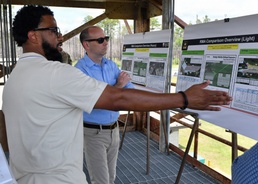
Fort Stewart-Hunter Army Airfield welcomed Assistant Secretary of the Army for Installations, Energy and Environment, Jordan Gillis, July 9 as he visited the installation and 3rd Infantry Division for the first time in his current position.
“Visits like this help us to see from the policy-making level, the actual impact of those policies,” Gillis said. “You see where the needs are and how potential policy can help address them.”
Fort Stewart leadership and key Directorate of Public Works leaders first took Gillis’ team to tour a set of non-remodeled VOLAR Barracks which were built throughout the installation from 1977-1983.
Kyle Wemett, Fort Stewart DPW chief of planning and engineering division, discussed the need for living spaces at a recent Real Property Planning Board held to inform key stakeholders.
Fort Stewart has over 1,750 VOLAR barracks spaces that do not meet the current Army standard for quality of life, Wemett said. He added the barracks spaces will be renovated over time through the Facilities Infrastructure Plan with the last of the barracks spaces projected to be completed in fiscal year 2038.
During the barracks tour, Marne Innovation Center leadership presented their Mold Conditions Awareness Tool, which was thought of by a barracks manager and brought to life through the MIC.
For Staff Sgt. Joriah Davidson, a barracks manager in 10th Brigade Engineer Battalion, the MCAT has helped him immensely with his job.
“It’s pretty neat because one day I went through and normally they’re all green, but one of them was yellow,” Davidson said. “I thought ‘what’s going on here’ and it was showing in the system that the temperature in the room went up 10 degrees. Come to find out the AC went out.”
Over 4,200 sensors have been placed in 87 barracks buildings throughout Fort Stewart-Hunter Army Airfield. All sending real time data to barracks managers, their deputies and the MIC.
Early detection of changes pertaining to temperature and humidity are helping to reduce the number of work orders related to mold.
At its height, over 2,000 work orders were being submitted for mold in a singular year. To date this year, that number is at 700, although that number is expected to rise a little more due to the prolonged hot summers of Coastal Georgia.
Even though the number of mold-related work orders has dropped significantly, the aging barracks still require attention in other areas. Kyle Daniels, Fort Stewart DPW chief of operations and maintenance, says they receive 2,500 work orders a month with 85% pertaining to barracks and HVAC issues.
Gillis later noted how much has changed and how much has stayed the same since first being here 27 years ago.
“On one hand, we have made great progress, specially building out the 2nd Armored Brigade Combat Team area, but on the other hand, the same barracks where I had Soldiers as a platoon leader, the current generation of leaders have Soldiers in those exact same spaces,” he said.
Gillis then visited the Rocky Warrior Dining Facility which was the front runner for the Army’s new campus style dining. The DFAC is a prime location for Soldiers to eat at but was closed 9 months ago after continuous service orders revealed structural defects. The DFAC is projected to be open in the second quarter of fiscal year 2027.
Wemett discussed the required budget to complete the CSDV projects at the most recent Real Property Planning Board.
“One dining facility required seven million dollars to complete the primary CSDV location,” said Wemett. “The second CSDV site will require an additional $12 million to complete the conversion for the facility.”
Completing these projects will increase quality of life for Soldiers by providing dining options within appropriate proximity of living spaces.
In the interim, Fort Stewart was selected to integrate the Flexible Eating and Expanded Dining program in late summer. This program allows Soldiers to utilize their meal entitlements at participating AAFES food concessionaries instead of limiting them to Army dining facilities and Army food trucks.
“Fort Stewart offers some very real and relatable examples of how prioritization of funds has a direct impact on the ground at installations,” Gillis said. “For instance, you take the needs ID’d by campus-style dining, apply those across the board to other priorities that we diverted funds from to address the requirement and the cascading effect it has. It’s a great use case to show Army senior leaders, as well as our partners across the river on Capitol Hill, what it means to manage priorities in the face of scarce resources.”
After lunch at a different DFAC, Gillis ventured out to the Rail Marshalling Area, which is where units load and unload equipment on trains before and after training or deployment. The Fort Stewart RMA currently contains only two rail spurs compared to other Army installations like Fort Carson, Colorado, and Fort Riley, Kansas, which contain 14 tracks and are home to similar organizations.
The proposed expansion adds four more rail spurs and a container handling facility. This would make the Fort Stewart RMA comparable in size to Fort Bragg, North Carolina, which has 10 tracks, and Fort Campbell, Tennessee, which has 8 tracks and are home to light units.
The rail expansion is Fort Stewart’s top priority for military construction requiring almost $80 million to complete. Additional rail projects include the rail passing track expansion and a new railroad engine house, totaling an additional $14 million to complete.
Those upgrades give Fort Stewart and 3rd ID the ability to deploy an armored combat team in 96 hours, meeting the XVIII Airborne Corps requirement.
“Installations, like Fort Stewart, have key missions to execute for the Army, and with 3rd Infantry Division being the Army’s premier rapid deployment armored force, you must be able to understand how the decisions made at the headquarters level affect the Army’s mission at a more tactical level,” Gillis said.