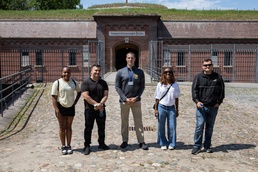
POZNAŃ, POLAND – In the historically rich city of Poznań Poland, there are lessons to be learned behind every corner. What stories do old buildings tell and who among us is willing to tell them?
At Fort VII, one Soldier answered the call.
The remnants of the fort, which are over 150 years old, hide a unique story. For Pennsylvania Army National Guard Staff Sgt. Jonathan Mateja, it is a window to Poland's current cultural foundation. Mateja takes pride in being a certified tour guide for Fort VII, and performs these tours for newly arrived Soldiers to help them learn more about Polish history and build bonds. To him, history is another avenue to connect with the people around us.
"Understanding the past helps us understand the people we're working alongside," Mateja said. "I've always believed history informs how we got to where we are today,"
That perspective has given him more meaning in his assignment in Poland. It began at his youth growing up near Valley Forge in southeastern Pennsylvania. This is where, at an early age, Mateja developed an appreciation for American and European history. Surrounded by veterans in his church community, many of whom had experienced the second World War, he learned that history was best understood through personal experiences.
“I had a lot of veterans in my church, both American and Polish. So, getting to hear their stories growing up and learning it all. . .It really drove me to keep researching history and teach that history to others.”
Mateja frequently guides fellow Soldiers through historical sites across Poland, including Fort VII in Poznań—the first concentration camp established in German occupied Poland. For many Soldiers, the visit is their first exposure to a lesser-known chapter of the Second World War.
"Most people have never heard of Fort VII," Mateja said. "They don't realize this is where the first experiments with mass poison gas killings started before expanding those methods elsewhere."
Walking through the dimly lit ammunition stores, damp corridors, and cramped iron cells, provides Soldiers with more than historical facts. It offers context for understanding the resilience of Poland and its people and why preserving history matters. It illustrates that behind this often unknown corner of Wielkopolskie, Poznan is an inspiring story of resilience. Rather than just viewing history as something that repeats itself exactly, or that it should be ignored and disregarded, Mateja encourages Soldiers to recognize recurring patterns or "rhymes."
"There are often rhymes in history," Mateja said. "It's not the same event happening again, but you can recognize similar circumstances and understand why people respond the way they do."
He believes that understanding Poland's experiences during the second World War, from the occupation, resistance, recovery, and its post soviet boom, helps Soldiers appreciate the nation's modern identity and strengthens relationships with one of America's closest allies.
"What happened here shaped the Polish people," Mateja said. "When Soldiers understand that history, they better understand the country they're serving in today."
Soldiers that attended attest that the tours Mateja has done left an impact.
U.S. Army Reserve Spc. Thomas Madrzak, assigned the 366th Mobile Public Affairs Detachment, illustrated “The tour has given me a new perspective in how I view and interact with this country (Poland). To see how they recovered and built something after so much hardship is nothing if not astounding.”
Leading discussions and tours through sites of remembrance, Mateja hopes every interaction leaves Soldiers with a deeper appreciation for both the people they serve alongside and the lessons of the past.
“It's good to have someone there with you to guide you. And so, seeing soldiers leave with that profound sense of, ‘Wow’,” Mateja said, highlighting Soldiers' reaction to the tours.
In Poland, there are many stories of heroism and resilience against all odds and hardships. The tour at Fort VII is just an example of how history is a path to building friendships and understanding. This fort symbolizes more than just context, it displays the culture and a people's resolve to push onward. Not just how it happened and why, but what people do with the experience and how it shapes the way Soldiers interact with the people of that nation.
"History isn't just about remembering what happened," Mateja said. "It's about understanding people."