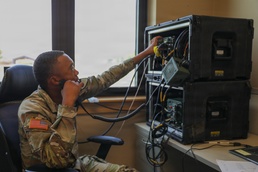
FORT HOOD, Texas – Soldiers with the 11th Corps Signal Brigade and 1st Cavalry Division conducted the annual High Frequency Skills Challenge, a high power, high frequency (HF) radio communication exercise held from July 21 to 23, 2026, on Fort Hood, Texas.
The challenge, hosted by the U.S Army Network Enterprise Technology Command, (NETCOM) exists to train Soldiers on foundational field radio procedures, testing both equipment capabilities and operator ingenuity.
The training highlights the art, science and technical expertise of HF radio communication by providing operators the opportunity to master the fundamentals of radio theory, antenna optimization and low to high power constraints. These fundamentals allow the operators to maintain the commander’s Primary, Alternate, Contingency and Emergency (PACE) communications plan. Although modern military operations rely on satellite communications, these networks can be jammed or disabled. HF radio systems play a crucial role as the primary backup system to keep a unit connected during large-scale combat operations (LSCO) when satellite and line-of-sight systems fail.
Command Sgt. Maj. Matthew Helmer, the command sergeant major of the 11th Corps Signal Brigade, discussed the importance of the challenge in cultivating radio operators with effective communication skills, critical for mission success.
“The annual NETCOM HF Skills Challenge is a great arena for Soldiers to train and develop HF skills that will be a critical PACE option for commanders in the LSCO fight,” said Helmer. “What is truly important about this specific event is the criteria and grading that NETCOM provides to enhance operator’s basic skills on HF operations. Our overall goal is to produce communicators that have the skills to operate all means of transport to get the message through.”
Staff Sgt. Cedric Macklin, a Theatre Spectrum non-commissioned officer with 62nd Expeditionary Signal Battalion-Enhanced, 11th Signal Brigade, discussed how the HF radio system is one of the most crucial tools for beyond line of site (BLOS) communication.
“One of the best beyond line of sight tools is the HF radio,” said Macklin. “Because it bounces off into the ionosphere and the atmosphere and back down, depending on the power and how you adjust your antenna set.”
Macklin continues by describing how the radio systems are essential for communication and effectively dominating the battlefield.
“The importance of this is to be able to communicate and have our commanders communicate on the battlefield,” said Macklin. “We’re coming into different conflicts where we would need these capabilities to make sure that our command groups, our command teams can effectively dominate the battle space seamlessly even when there’s things that interject our communications aspects.”
The HF Skills Challenge is open to all Soldiers on Fort Hood, allowing all Soldiers the opportunity to participate by learning the tools required to manage the radio systems and compete in the HF radio competitions.
“Sgt. Maj. Helmer is very instrumental in Fort Hood being a leader of the HF Competitions,” said Macklin. “We have placed very high the last two years in these competitions and he wants to make sure that it is open to all of Fort Hood, so that we as signalers can help train those across Fort Hood. But also that whatever conflict or situations where systems like this become essential, we can be able to still accomplish our missions and be able to accomplish the task.”
Pfc. Tyler Lavender, a network communications system specialist with Expeditionary Signal Battalion-Enhanced, 11th Signal Brigade, and a participant in the HF Skills Challenge, discussed the hands-on training implemented during the training.
“I really enjoy learning new things," said Lavender. "When I participated in the competition, the QRPX in March, it gave me the opportunity to learn a little bit more about different equipment I didn’t really know about. Coming back this time, actually getting a little more hands on it, provides me with valuable knowledge to pass down to those in my unit. It’s really nice and I’m glad we have this opportunity on this base.”
Lavender also described how the training will prepare him for competing in the Noble Skywave Competition in October.
“For the challenge, what I am going to be doing is getting a list of signals that are up to try and make contact with them," explained Lavender. "Whether that be through voice, email or textchat, making sure that equipment is working properly and getting more hands-on training so that when Noble Skywave Competition comes up in October, I am prepared.”
The Noble Skywave Competition, hosted by the Canadian Armed Forces, is scheduled to occur next October. The competition promotes international interoperability, technical expertise and tactical readiness in HF radio systems. Operators work alongside teams from allied countries, military auxiliary systems, and civilian partners in unpredictable environmental conditions. They are tested on their ability to transmit long-range signals over thousands of miles. Operators rely on their own skills to manually select the correct frequencies, configure antennas and establish connections.
Operating HF radio systems ensures mission success by allowing commanders to maintain reliable communication with their units in the event of a satellite communications failure during large-scale combat operations.
(U.S. Army article by Cpl. Brandi Frizzell)