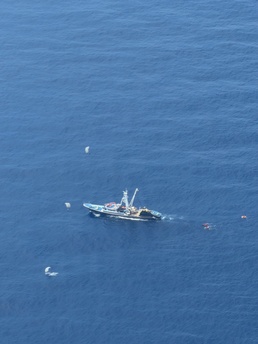
TYNDALL AIR FORCE BASE, Fla. — In a powerful demonstration of binational cooperation and a shared commitment to humanitarian assistance, U.S. Air Force rescue forces and the Armada de Mexico under the Secretariat of the Navy (Marina) seamlessly coordinated to save the life of a fisherman critically injured 680 nautical miles off the coast of Cabo San Lucas, Mexico.
The complex rescue highlights the enduring partnership between the United States and Mexico, emphasizing a mutual dedication to safeguarding lives across shared waters and demonstrating the trust between the armed forces of both nations.
The coordinated response began late in the evening when the U.S. Coast Guard requested specialized long-range medical evacuation capabilities. Recognizing the urgency of the fisherman’s condition, the Air Force Rescue Coordination Center (AFRCC) at Tyndall Air Force Base, operating under Air Forces Northern (AFNORTH), quickly synchronized efforts and tasked the 129th Rescue Wing (RQW), based out of Moffett Federal Airfield, California.
Within hours of accepting the mission, the 129th RQW launched an HC-130J Combat King II aircraft carrying four Pararescuemen (PJs) from the 131st Rescue Squadron. In a highly technical operation, the PJs executed a precision parachute jump into the open ocean, swimming to and boarding the fishing vesselFranzto provide immediate, life-saving medical care to the critically injured mariner.
" This successful save demonstrates how the AFRCC is able to rapidly coordinate with interagency and international partners to project life-saving capabilities across vast distances," said Lt. Col. Brian Scott, director of the Air Force Rescue Coordination Center. "The seamless communication between our controllers, the U.S. Coast Guard, and the Armada de Mexico, coupled with the unmatched technical proficiency of the 129th Rescue Wing's Airmen, ensured we could deliver critical care to a mariner in distress when every minute mattered."
Following the initial medical intervention, the PJs stabilized the patient and remained by his side as the vessel transited toward Isla Socorro, a Mexican naval station. The following day, working in close coordination with Mexican authorities, the 129th RQW dispatched a second HC-130J to land at the island, extract the rescue team, and finalize the medical transfer. Upon arrival, the U.S. Airmen officially transferred the patient into the care of the Armada de Mexico. This rapid transition of medical control on Mexican soil facilitated the final leg of transport to higher-level care, exemplifying the operational compatibility and seamless communication between the two countries.
"The flawless execution of this mission by the Air Force Rescue Coordination Center, the 129th Rescue Wing and our partners in the Armada de Mexico represents the highest standard of regional security cooperation," said Lt. Gen. Luke Ahmann, commander of Continental U.S. NORAD Region and First Air Force (Air Forces Northern and Air Forces Space). "Our bilateral training and shared focus on humanitarian assistance ensure that we stand ready to deliver life-saving support wherever and whenever it is needed." Through joint training, shared expertise, and a unified response network, the U.S. and Mexico continue to demonstrate that the bonds of neighborly solidarity and our shared commitment to saving lives transcend geographic borders.
"This complex rescue operation is a clear demonstration of the strong partnership and mutual respect between the United States and Mexico,"said Gen. Gregory Guillot, commander of U.S. Northern Command and North American Aerospace Defense Command."The outstanding professionalism of our rescue forces, combined with the seamless coordination of the Armada de Mexico, underscores our shared dedication to safeguarding lives at sea. Operations of this complexity highlight the deep operational trust and interoperability we continue to build together."
After successfully handing off the patient to their Mexican counterparts, the U.S. Pararescuemen were safely extracted and returned to Moffett Federal Airfield to conclude the mission.
Together, the combined efforts of the AFRCC, the 129th RQW, and the Armada de Mexico, which functions as the Coast Guard, resulted in one life saved, a powerful testament to the strength, respect, and enduring nature of the U.S.-Mexico partnership.
The Cabo San Lucas rescue is one of many operations coordinated daily by the AFRCC, which operates 24/7 at Tyndall Air Force Base. Acting on behalf of the commander of U.S. Northern Command, who serves as the U.S. Inland Search and Rescue Coordinator, the AFRCC is the single federal agency responsible for coordinating airborne and on-land SAR activities across the contiguous 48 states. Crucially, the AFRCC maintains tight operational ties with Mexico and Canada to ensure mutual civil SAR support across all of North America.
So far this year, the AFRCC's relentless operational tempo has resulted in the coordination of 7,497 search and rescue incidents. These efforts have led directly to the launch of 282 lifesaving missions, ultimately culminating in 151 saves across North America. These numbers stand as a daily testament to the high-stakes, around-the-clock nature of the center's mission and its ongoing promise to deliver hope when and where it is needed most.