Stalking and striking — that’s the goal of an emerging initiative by the U.S. Army, intended to put loitering munitions in the hands of Soldiers by the summer of 2028.
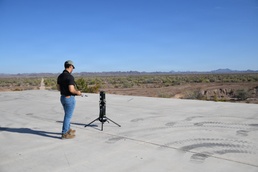
Product Manager Precision Strike & Reconnaissance Systems (PSRS) is conducting risk reduction testing of four vendors at Yuma Proving Ground (YPG) for the Low Altitude Stalking and Striking Ordnance (LASSO) initiative.
Aviation Systems and Electronic Test Division test engineer Walter McCormick explained how the LASSO assets work.
“Soldiers would be patrolling an area. A couple of miles down, there’s a tank up the road. They would send one of these up to fly over and take the tank out.”
While the concept is not new, the difference, McCormick says is the “man-portable” aspect.
These systems are designed for the airborne and ground Soldiers, they are man packable.
“A Soldier would have their Fire Control System and fly it like any drone. Turn it on, launch it and fly it into the area. There’s a camera on it, a daytime and an IR [Infrared] camera so you can see heat signatures then just fly it out to that general area, see the target and then initiate or blow it up basically.”
The systems can also perform waypoint following, meaning using coordinates to send the munition airborne autonomously patrol the area, then the user engages the target.
“They are backpack portable, one or two people can launch it, and you don’t need a lot of support asset,” explained McCormick.
Tim Van Goethem, a PSRS test engineer who has attended various testing in Yuma said, “As part of another risk reduction test, we are going to be testing four times here in Yuma. This is the first step, and we will have the live-fire warhead test in November.”
Test Officer Myra Angulo who was on-site for the initial test explained that YPG is conducting safety flights to ensure the safety contingencies work as intended before using explosives on the systems.
“They are testing their lost link to make sure it returns to where it is supposed to. They check the geo-fence which is a safety boundary so when it’s armed, it doesn’t leave the fly box.”
The four test items will also undergo rigorous conditioning chambers, rough handling, and climactic testing to conclude with high explosive flight tests to assess its reliability and durability.
Van Goethem said, “So far, it’s gone pretty well. I appreciate all the support we have been given at YPG and I hope to have many more tests out here in the future.”
YPG’s role is vital because data collected will aid PSRS in fielding decisions.
“The overall goal is to get all four vendors fielded and then from there start seeing the differences,” said McCormick and determine which will end up in the Soldiers’ hands.