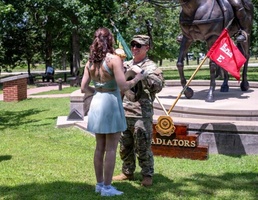
FORT LEONARD WOOD, Mo. — It is unmistakable. It is iconic. To wear it is to carry the weight of transforming thousands of civilians into U.S. Army Soldiers. For the noncommissioned officers who earn it, the drill sergeant campaign hat means everything — making the moment they finally remove it and leave the trail one of the most pivotal of their careers.
Maneuver Support Center of Excellence Drill Sergeant of the Year, Sgt. 1st Class Terrence Johnson, said the day he earned his campaign hat the true gravity of his responsibilities set in.
“It is leading, coaching, mentoring and upholding the highest standards within initial entry training, and passing down a legacy of professionalism and responsibility,” Johnson said. “The hat embodies tradition and Army pride.”
Johnson said that is why a de-hatting ceremony is a deeply significant milestone representing the culmination of years spent on the trail, dedicating every day to building thousands of disciplined Soldiers.
“A de-hatting ceremony is when a drill sergeant completes their assignment or retires from their role. The ceremony typically involves the formal removal of the drill sergeant campaign hat,” Johnson said. “It solemnly marks the end of the drill sergeant’s service and the passing of responsibility to a successor. It also acknowledges the sacrifices, discipline, and leadership provided during their tenure. The ceremony ensures that no drill sergeant’s contributions fade from institutional memory.”
To mark the milestone for three Fort Leonard Wood drill sergeants returning to the force, a timed honored, symbolic military tradition took last month at Memorial Grove when the noncommissioned officers removed their drill sergeant hats for the final time.
After three years, and training more than 1,500 Fort Leonard Wood Soldiers, one of the drill sergeants hanging up her hat was Staff Sgt. Angel Singh-De Leon, who served as a senior drill sergeant with Company B, 795th Military Police Battalion.
“The part that I liked most was watching the transformation from a civilian to a Soldier,” Singh-De Leon said. “It is rewarding to see what they knew prior to joining and how much knowledge they get once they complete the training.”
Singh-De Leon had the opportunity to share the de-hatting ceremony with fellow drill sergeants, Staff Sgts. Gage Jurumbo and Dionnabel Camilo.
Jurumbo served as a drill sergeant for the 795th Military Police Battalion and Camilo with the 35th Engineer Battalion.
Driven by a lifelong calling to lead, Jurumbo, who served as a drill sergeant for two years, said he is eager to continue shaping and mentoring Soldiers as his Army career progresses beyond the trail.
“I didn’t let the campaign hat change the type of leader I am. Yes, we must instill standards and discipline in the trainees as drill sergeants, but at the end of the day, we’re still noncommissioned officers, leaders of Soldiers,” Jurumbo said.
For Camilo, who wore the hat for three years, being a drill sergeant is more than just a job.
“The memories that stand out to me while being on the trail were the times trainees will come up to me after graduation to shake my hand, thank me and tell me that I made an impact in their lives”, Camilo said. “This is a humble reminder that sometimes as a drill, you believe that it’s just your job to teach, coach and mentor but to the trainees and their families, you are much more.”
As is mentioned in the U.S. Army Drill Sergeant Creed “I will assist each individual in their efforts to become a highly motivated, well disciplined, physically and mentally fit Soldier, capable of defeating any enemy on today’s modern battlefield.”
Johnson expressed pride that these three Soldiers could properly mark the conclusion of their drill sergeant tour before reverting to the line.
“It reflects respect for the individual’s status as a drill sergeant and marked the respectful closure of a challenging assignment,” Johnson said.
For more information about being a drill sergeant, visit the [U.S. Army’s drill sergeants website](https://www.army.mil/drillsergeant/).