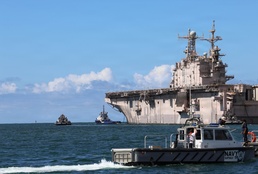
PACIFIC OCEAN - Ships and aircraft participating in exercise Rim of the Pacific (RIMPAC) 2026 conducted a planned, live-fire sinking exercise (SINKEX) and sank decommissioned USS Mobile Bay (CG 53), July 12, 2026, and decommissioned USS Peleliu (LHA 5), July 17. Mobile Bay and Peleliu were sunk in waters 15,000 feet deep, more than 50 nautical miles off the northern coast of the island of Kauai.
“Watching our Sailors work side-by-side with partners from around the world, executing complex maritime events together, is the strongest reminder of why these relationships matter," said U.S. Navy Vice Adm. Jeff Jablon, the RIMPAC 2026 Commander, Combined Task Force (CCTF). "SINKEXs are a prime example of the strength and readiness our partnerships create.”
During the SINKEXs, participating units from Australia, Canada, Italy, Japan, New Zealand, Spain and the U.S. Navy, Air Force, and Army gained proficiency in tactics, targeting and live-firing against a surface ship at sea. Live-fire exercises deliver hands-on, realistic training that sharpens partner nations' capabilities to coordinate, plan and execute sophisticated maritime operations, including precision targeting and strike capabilities.
"The successful execution of multiple SINKEXs highlights the unbreakable bond and growing capability of our coalition,” said Republic of Korea Navy Rear Adm. Inho Kim, RIMPAC 2026 Combined Force Maritime Component Commander (CFMCC). “Together, we are demonstrating a shared commitment to regional stability by developing tactics and skills in maritime operations."
A SINKEX is conducted only after the area has been surveyed for the presence of people, marine vessels, aircraft, and marine species. SINKEXs are planned in compliance with the National Environmental Policy Act and executed in accordance with the Navy’s permits and authorizations under the Marine Mammal Protection Act, Endangered Species Act, and Marine Protection, Research, and Sanctuaries Act.
Mobile Bay, a Ticonderoga-class guided missile cruiser, was commissioned on Feb. 21, 1987, at the Alabama State Docks in Mobile, Alabama. Homeported in Mayport, Florida, until 1990, the cruiser then joined the U.S. 7th Fleet in Yokosuka, Japan. Over three decades of service, Mobile Bay supported Operations Desert Shield, Desert Storm and Iraqi Freedom, and delivered humanitarian assistance following the 1991 Mount Pinatubo eruption in the Philippines. Mobile Bay was decommissioned in August 2023 after over 36 years of naval service.
Named for the World War II Battle of Peleliu, the Tarawa-class amphibious assault ship was commissioned on May 3, 1980, and homeported in San Diego. With a displacement of nearly 40,000 tons, the ship launched a variety of aircraft from its formidable flight deck while conducting combat operations and humanitarian missions across half the globe. LHAs are the largest of all amphibious warfare ships, resembling a small aircraft carrier.Across 17 deployments, Peleliu supported Operations Desert Storm and Iraqi Freedom and delivered humanitarian assistance following the 1991 Mount Pinatubo eruption in the Philippines and the 2010 Pakistan floods. Peleliu was decommissioned in March 2015 after 35 years of naval service.
Thirty nations, 30 surface ships, five submarines, 15 national land forces, more than 190 aircraft and 30,000 personnel are participating in RIMPAC in and around the Hawaiian Islands, June 24 to July 31. As the world's largest combined-joint maritime exercise, RIMPAC provides a unique training opportunity that fosters cooperative relationships among participants. These partnerships are critical to ensuring both the safety of sea lanes and security across the world's oceans. RIMPAC 2026 is the 30th exercise in the series that began in 1971.