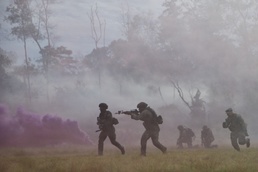
KOTA BELUD, Malaysia — U.S. Army Soldiers from the Guam National Guard and Malaysian Army troops from the 5th Infantry Division traded simulated fire in a force-on-force exercise July 22, 2026, replicating battlefield conditions without live ammunition as part of Exercise Keris Strike.
Held July 16-26 in Kota Belud, Keris Strike 26 brings together U.S., Malaysian, and Australian Defence Force personnel. Alongside the force-on-force engagement, the exercise featured mortar fire drills, medical evacuations, sling-load operations, and coordinated infantry maneuvers.
During Wednesday's simulated battle, U.S. and Malaysian forces used the Multiple Integrated Laser Engagement System, or MILES, evaluated by U.S. Army observer-coach-trainers to measure operational readiness.
Weapons fired coded laser pulses, while sensors on vests and helmets registered hits to track who fired and who was "wounded" or "killed." The system provided commanders with detailed data to evaluate performance, sharpen tactics and strengthen coordination across allied units.
Observer Coach Trainers monitored the exercise, assessing how units executed missions under stress and ensuring standards were met to prepare formations for future deployments. Combined with after-action data reviews, the simulated battles delivered combat realism by immersing soldiers in the complexity of warfare.
"We’re evaluating how units maneuver across danger zones, obscure their approach, call for fire and clear buildings in an urban environment," said Sgt. 1st Class Nathan Basham, an OC/T with the Joint Pacific Multinational Readiness Center. "It’s about seeing how quickly they respond when casualties occur or leaders go down, and who steps up to keep the mission moving."
The training also plays a major role in leadership development. Officers and noncommissioned officers refined their command-and-control skills in complex multinational environments, learning to coordinate diverse units and adapt to dynamic battlefield conditions.
The primary focus of Keris Strike is interoperability — enabling U.S., Malaysian, and Australian forces to coordinate effectively during real-world missions and strengthen allied cooperation across the Indo-Pacific.
"Working with our Malaysian partners showed us the value of interoperability," said 1st Lt. Takeshi Abrahamsson, commander of Charlie Company, 1st Battalion, 294th Infantry Regiment, Guam Army National Guard. "They know the terrain and the fastest routes through the jungle, while we bring different tactics and technology. Despite language barriers, once we demonstrate a task, they pick it up quickly. We learn from each other every day, and that exchange builds stronger procedures, stronger units, and stronger partnerships.