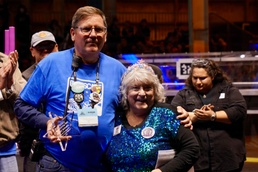
Dan Byrd’s venture into robotics mentoring began in 2018 with a late-night phone call from his son Robert, whose high school team needed a hand readying its robot for a fast-approaching competition: “Dad, can you help?”
Byrd hadn’t exactly worked on robots, but he tapped his experience as a machinist’s mate in the Navy and an Underway Replenishment (UNREP) engineering technician at Naval Surface Warfare Center, Port Hueneme Division (NSWC PHD) — “all shop skills,” he said — to assist Robert’s Roboticus team at Rio Mesa High School in Oxnard, California.
Now UNREP Test Site manager, Byrd came to the command as a sailor in 2003 and then started working in UNREP as a civilian in 2007 after retiring from active duty.
Over the eight years since his son asked for help, Byrd has been spending much of his free time volunteering as a mentor for four local high school robotics teams. He’s quick to point out that the students take the helm of their own projects.
“As mentors for student-led teams, we stand back and let them make their mistakes,” Byrd said. “Our job is to basically guide them, just like you’d mentor a young engineer here (at NSWC PHD).”
Teams that participate in For Inspiration and Recognition of Science and Technology (FIRST) Robotics build their machines to tackle tasks involved in the competitions — for example, picking up and throwing balls. The students get the details and parts specific to the game at the start of the season. Then they go to work on computer-aided design, fabrication, wiring and programming to bring their creations to life.
The teams that Byrd mentors also work with teachers and have facilities at their schools with varying levels of equipment. One has a full machine shop; another has a few power tools. In any case, the students’ efforts fuel their success, according to Byrd.
“My team with the least-equipped shop ranked the second-highest of the teams I worked with,” he said.
Byrd applies for grants for his teams each year through the Department of War Science, Technology, Engineering and Mathematics (DOW STEM) program. This year, each of his four teams received a $3,000 grant, which covered half the cost of their event entry fees for the regular season.
Byrd has also spent his own money and leave time to travel to competitions elsewhere in the state. From March 27 to 30, he joined his Ventura High School team, Ventura Robotics, at a FIRST district event in Clovis, California, nearly 250 miles from Port Hueneme. The team placed third, which qualified it for the FIRST California Southern State Championship, held in Anaheim from April 9 to 12.
The competitions are “rough and tumble,” in Byrd’s words, with robots zigzagging around courts strewn with balls, goals and ramps and frequently colliding with each other like bumper cars. The students program their creations to operate autonomously for the first 20 seconds of a match, and then they remotely pilot them.
Casualties are common. For instance, the lidar unit on Ventura’s robot took a hit when another competitor caught air off a ramp and crashed into it. Students may need to repair their robots at the competitions, and they typically rebuild them multiple times throughout the season.
The students build skills such as machining, welding and coding, as well as project management and teamwork. They also learn how things work together in the “big picture,” according to Byrd.
“They know the mechanical needs to mesh with the electrical and with the programming, and they know cost matters,” Byrd said. “They do on a smaller scale what we do every day (in the Navy).”
It’s not just about robots, he added, but about the students unlocking their potential and preparing for college and careers.
“Really it’s that they get their eyes opened to what they can actually accomplish,” Byrd said.
Robert Byrd stayed connected with FIRST Robotics during his college years, primarily pitching in as emcee or announcer for competitions. He recently graduated from California State University, Sacramento, with a degree in mechanical engineering.
Dan Byrd points to his son’s experience as an example of why he keeps mentoring students in FIRST Robotics.
“You have to give back,” Byrd said. “I see my son, who started in this program, who got that spark to become an engineer.”
More broadly, Byrd said that DOW STEM robotics mentors contribute to building up the next generation of technical experts the Navy needs — perhaps including a future UNREP Test Site manager.
“We’re mentoring our replacements,” he said.