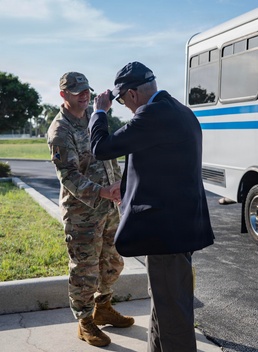
CAPE CANAVERAL SPACE FORCE STATION, Fla. -- On June 26, 2026, the Council on Foreign Relations visited Cape Canaveral Space Force Station. Members of the CFR met with Space Force Col. Brian Chatman, commander of Space Launch Delta 45, to discuss the scale of Space Coast operations, spaceport logistics and ways to ensure Cape Canaveral Space Force Station remains the “Premier Gateway to Space.”
The CFR is a nonpartisan, United States-based think tank with its headquarters in New York City. The council focuses on international affairs and their relation to U.S. interests. Members discuss these global challenges with government officials and scholars to advocate for policy changes that are better postured to address international and national issues.
During their initial meeting, Chatman, along with members of the 45th Civil Engineer Squadron, briefed the group on the Spaceport of the Future program and SLD 45’s readiness to overcome Eastern Range challenges. The Spaceport of the Future program outlines all infrastructure updates necessary for an impending, increased launch tempo. He also underscored the importance of safety for all personnel on the Eastern Range.
On May 28, 2026, Blue Origin suffered a hotfire test anomaly of their New Glenn rocket. This anomaly resulted in the largest explosion ever documented on the Space Coast. It reinforced that safety procedures are integral to the launch mission. This anomaly highlights the importance of keep-out areas, raising critical questions about how the spaceport will adapt to larger launch vehicles like New Glenn, a conflict the CFR documented.
“I expect every Airman and Guardian operating on the Space Coast toembraceredundancy and embody resiliency,” said Chatman. “Our personnelhave the tools and the skillsets necessary to address any conflict that threatens mission success.”
Additionally, the engagement focused on the intersection of national security policy and financial markets. The team discussed the strength of the U.S. industrial base and the growing importance of commercial integration, emphasizing how acquisitions and private markets work in tandem to sustain long-term space capabilities. It proves effective in ensuring the U.S. leads in space superiority. This partnership also guarantees the resilience of space launch on a national level as U.S. Space Force payloads can launch on any privatized launch vehicles.
“As global space competition increases, U.S. space-based assets must develop to outcompete foreign adversaries in this domain,” said Space Force Col. Corey Trusty, military fellow at the CFR. “It is important that Cape Canaveral SFS efficiently receives the necessary infrastructure upgrades to ensure it remains the most productive spaceport in the world.”
Over lunch, the CFR met with representatives visiting from U.S. Southern Command for a crosstalk opportunity focused on the role SLD 45 and the space domain play with respect to SOUTHCOM and other nations in the Western hemisphere. These ten representatives were military officers from nine different South American countries. The visitors’ ranks spanned from colonel to major general. Outside of their lunch with the CFR, these SOUTHCOM representatives toured Cape Canaveral SFS and learned about the personnel and infrastructure systems of the growing U.S. Space Force.
In the afternoon, the CFR delegation transitioned from policy discussions to a firsthand look at these operations during a comprehensive tour of Cape Canaveral SFS. The tour visually reinforced the sheer scale of the Eastern Range and the logistical choreography necessary to safely support simultaneous, back-to-back missions.
The opportunity for these two groups to engage with each other and the launch experts at SLD 45 helped drive conversations that bridged national, strategic goals for the U.S. and our partner nations with current, operational realities. As a nation, collaborative innovation fuels success. Bringing together stakeholders, researchers and subject matter experts ensures the requirements necessary for assured access to space and a premier, U.S. launch enterprise.