Little Rock, Ark.- One of the defining features of the Department of Defense’s Cyber Shield exercise is the partnership of servicemembers and civilians to collaborate in order to reach new heights in cyber security. From a strategic standpoint, national leaders highlight the importance of the connectedness between the uniformed service and the private sector.
Congressman French Hill of the Second Congressional District in Arkansas addressed the participants of Cyber Shield 2026, offering accolades for the type of critical collaboration of the exercise. He said to the room of over one thousand participants, “This is a massive, multi-state, multi-territory undertaking. But its brilliance lies not just in its size, but in its composition. In the modern era, the line between military infrastructure and civilian life has effectively vanished. When our power grids are targeted, it is not just a military concern; it is a civilian crisis.”
Power grids are top of mind for this year’s exercise because participants are training with a focus on this critical infrastructure that sits at a crosspoint of both government and the private sector. This focus highlights the type of national security threat that demands cooperation from multiple levels of government combined with trusted and developed relationships with industry leaders in the private sector.
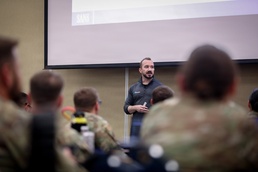
Jason Christopher is a course author and instructor with the SANS Institute, a global cybersecurity organization that provides training and resources in the field to practitioners. As a first-time instructor for Cyber Shield, Christopher highlighted the benefit of private industry collaboration saying, “From the private sector side, we do have some lessons learned that I don’t think have been shared as broadly as they could be.”
The consistent focus on emerging threats is a central theme for both service members and civilians. For this particular course, that means taking a deeper dive into Industrial Control Systems, which is the network of systems that manage the critical infrastructure. Christopher emphasized the need for further training in this field, “Industrial Control Systems (ICS) security is very different from traditional IT security, which has a lot of culture around it. The threats are evolving so much on the ICS side, and we are doing very well in training the practitioner, but the leader then has to lead that very well-trained practitioner.”
The Cyber Shield exercise utilizes the partnership between troops and civilians to bridge the gap in both technical expertise and leadership within the field. This type of cooperation is the backbone of the entire exercise. As Congressman Hill stated, “This is why Cyber Shield is so revolutionary. It acknowledges that the defense of this nation cannot rest on the shoulders of the military alone. By inviting civilian experts-- our engineers, our network architects, and our private-sector tech leaders-- into these simulations, the Department of Defense is creating a unified front.”