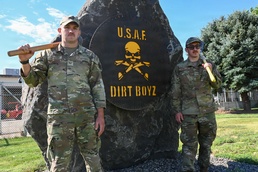
MOUNTAIN HOME AIR FORCE BASE, Idaho – They saw the smoke first. Three minutes later, they were looking at flames. Winds were intensifying, visibility was dropping and the fire was moving fast — there was no time to wait for help. That's when two Airmen decided to protect a neighborhood on the edge of crisis.
What started as an off-duty landscaping job quickly turned into an emergency response effort when U.S. Air Force Tech. Sgt. Reuben Krueger, a pavements and construction equipment craftsman, and Senior Airman Joshua Workman, a pavements and construction equipment journeyman, both assigned to the 366th Civil Engineer Squadron, found themselves working directly in the path of a fast-moving brush fire in Mountain Home on May 26, 2026. Their experience maintaining firebreaks and operating heavy equipment at Mountain Home Air Force Base helped them quickly recognize the danger, organize a response and adapt as the fire intensified.
"We walked around the building and saw a fire moving toward families’ homes, and immediately thought how dangerous it looked,’” Workman said. "We quickly realized that standing still wasn’t an option, the situation was escalating."
They immediately shifted from landscaping to response efforts, alerting the homeowners, helping gather pets and belongings, and encouraging neighbors to begin preparing equipment to create defensive space around nearby homes. Using knowledge gained through their military training and experience operating heavy equipment, they coordinated with residents to establish improvised firebreaks intended to slow the fire's spread.
"Nobody fights a fire alone. The homeowners, the neighbors, everyone jumped in," Krueger said. "We just used the skills we had to help keep the situation from getting worse."
As conditions worsened, the group worked with tractors, shovels and available equipment to contain advancing flames.
"The smoke was insane, at one point you couldn't see three feet in front of you, " Workman said. "It was moving fast, but panic didn't help anyone. We focused on what we could do, and we were going to do it until it stopped."
According to Krueger, portions of the fire crossed existing breaks and required additional efforts by hand to contain hotspots near fences, utility areas and the edge of the property. Flames briefly moved over their position before they regrouped and adjusted their approach. Protecting the infrastructure nearby was becoming just as urgent as containing the fire itself.
"We looked back at the telephone poles and realized that was going to be a bigger issue," Workman said. "If power lines go down, then we have a whole different problem."
The Airmen estimated the fire advanced to within 25 feet of the home before conditions improved and containment efforts became more effective.
"We already knew what tools people had and how to use them," Krueger said. "Even small cuts with a mower made the flames manageable enough to work."
Every decision required immediate action. As the fire shifted direction, visibility disappeared and new hazards emerged, the Airmen credited their success to teamwork and maintaining composure under pressure.
"The same mindset we bring to the mission — stay calm, think clearly, act decisively — is the mindset that helped us out there," Workman said. "Training matters, even off duty."
By day's end, what began as two Airmen responding to an emergency quickly became a community effort, as residents joined together to cut firebreaks, move equipment and battle the advancing flames. By applying innovative problem-solving, decisive action and teamwork, their ability to lead under pressure exemplified the Gunfighter spirit, proving that the values forged in training extend far beyond the mission.