Planning in the training management cycle aligns prioritized training tasks with resources over time. In long-range planning, commanders publish command training guidance (CTG) with a long-range training calendar, providing subordinate commanders and leaders a clear vision of their training expectations. Units coordinate for resources and confirm resource management planning prior to training events during mid-range planning. In short-range planning, company and below units manage training primarily through company training meetings. At this planning stage training schedules are approved and published, final pre-execution checks and coordination are conducted, and resources are allocated. Company training schedules are the culmination of long-, mid-, and short-range planning and preparation. Through unit training management and producing training schedules, commanders ensure training is conducted on time, by qualified trainers, and with the necessary resources.
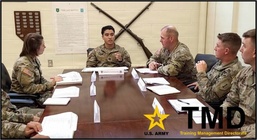
Training meetings review training just conducted, discuss planning for future events, and provide a platform for the commander to issue training guidance. (Training meeting how-to videos are available on the Army Training Network (ATN) at https://atn.army.mil.)
Company, troop, and battery training meetings are the center of gravity of unit training management. Successful training meeting focus includes—
Commanders conduct training meetings on the same day and time each week as part of the unit battle rhythm, providing predictability to the schedule. Training meetings are conducted to refine training guidance and training calendars. At battalion and brigade levels, these meetings focus on overall command training guidance progress and ensuring training resources for subordinate companies are coordinated and available when training begins. Company leaders conduct training meetings in any environment—at home station or deployed. They are also conducted regardless of the time management cycle the unit is in (green, amber, or red). To select a time to conduct training meetings leaders consider several factors. Main considerations include enabling leaders to attend, minimizing training disruptions, and allowing subordinate leaders time to prepare.
Good, efficient meetings come in many shapes and forms. The following techniques apply to all types of companies and platoons of the Active Army, National Guard, and Army Reserve—
As a culmination of long-, mid-, and short-range planning, resource coordination and allocation, commanders produce and publish company training schedules. The company commander signs and the battalion commander approves training schedules no later than 6 weeks prior to training execution, generally at the conclusion of the weekly battalion training meeting. Once the training schedule is signed, training is protected from distracters, and the company is ready to execute.
Training schedules are posted in company common areas and are provided to Soldiers when completed. At a minimum, company training schedules include the following information:
To enable predictability and consistent execution, events codified in a training schedule should not change. However, changes are sometimes unavoidable. Any substantive changes between Weeks T-6 through T-4 require battalion commander approval, changes between Weeks T-3 through T-2 require brigade commander approval, and any change inside Week T-1 requires division commander approval. Consistent changes occurring within two weeks of training indicate a commander’s failure to accurately plan unit training or a higher commander’s failure to protect subordinate units from unforecasted distracters.
Not all changes to approved training schedules require battalion commander or higher-level approval. Simple administrative changes such as references or instructors can be made by the company commander. Substantive changes such as dates, training tasks, or event cancellations require higher commander’s approval.
Training schedules refine specific actions to complete prior to training execution. Some short-range preparations include the following activities:
Short-range planning and preparation are complete when the unit is ready to execute training. Execution is the implementation of the commander’s long-range training guidance. It is the deliberate and purposeful accomplishment of each training event’s training objectives. Executing increasingly challenging training events, to the prescribed standard, develops increasingly capable, confident and lethal Soldiers, leaders, and units.
To learn more about short-range planning, training meetings, and training schedules, visit the Training Management Directorate. TMD, under Combined Arms Command, maintains training management podcasts, tutorials, and tools to help commanders and small unit leaders build sound training plans, conduct more efficient and informative training meetings and briefings, and successfully plan, prepare, execute, evaluate, and assess training exercises. Visit us today at https://atn.army.mil/.