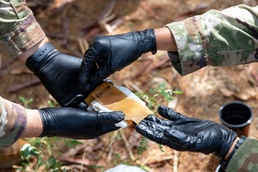
The Fight Before the Fight: Preventive Medicine Team Protects Force Readiness
By Mass Communication Specialist 1st Class Omar Rubi, U.S. Navy
NAVAL STATION GUANTANAMO BAY, Cuba — Long before a service member reports to sick call with a fever or stomach illness, a small team of preventive medicine professionals is already working to ensure that visit never happens. Assigned to Joint Task Force Southern Guard (JTF-SG), the Force Health Protection team monitors environmental hazards across Naval Station Guantanamo Bay to reduce disease and non-battle injuries (DNBI), helping keep deployed personnel healthy, mission-ready, and focused on their operational responsibilities. "Disease non-battle injuries can significantly impact readiness," said 1st Lt. Houston Bates, executive officer of the 224th Preventive Medicine Detachment and Chief of Force Health Protection for JTF-SG. "One way to look at our mission is to reduce the number of patients visiting the clinic because of mosquito-borne illnesses or contaminated water. Preventing someone from getting malaria or dengue fever is far better for the individual and for the healthcare system than treating those illnesses after the fact." While many associate preventive medicine with mosquito control, the mission extends well beyond insects. Bates and his team routinely evaluate drinking water, inspect environmental health conditions, assess air and soil quality, monitor noise hazards, and identify potential health risks before they affect personnel. "Our job is to prevent issues before they become problems," Bates said. "Much of our work involves ensuring water is safe to drink, shower with, and use throughout the installation. We also evaluate environmental conditions that could impact the health of the force." The concept of preventive medicine has shaped military operations for centuries. Bates points to Revolutionary War military leader Baron Friedrich von Steuben as an early advocate for environmental health after recognizing that poor sanitation at Valley Forge was contributing to widespread illness among Continental Soldiers. "When von Steuben arrived, he questioned why food was being prepared next to dead horses and open-air latrines," Bates said. "One of the first changes he implemented was moving latrines farther away from camp. Today, preventive medicine continues that same philosophy, identifying environmental hazards before they become operational problems." JTF-SG's preventive medicine mission is supported through a collaborative network of Army and Navy preventive medicine professionals stationed throughout Guantanamo Bay. Bates' team, deployed from Fort Hood, Texas, works alongside permanent preventive medicine assets supporting the installation, allowing specialists to rapidly share expertise when complex environmental health concerns arise. "Having multiple preventive medicine teams on the installation gives us the ability to troubleshoot problems quickly and leverage specialized expertise whenever needed," Bates said. Although their work often occurs behind the scenes, its impact is felt across every mission set on the installation. Healthy service members are better able to perform their duties without distraction from preventable illness. "I think an individual performs best when they're fighting one battle at a time," Bates said. "If someone is dealing with dengue fever from a mosquito bite or gastrointestinal illness from contaminated water, they can't focus completely on the mission. Our job is to eliminate those unnecessary distractions so our personnel can remain focused on protecting the mission." From testing water supplies to monitoring insect populations, JTF-SG's preventive medicine team represents one of the military's least visible but most essential capabilities. Their efforts ensure the Joint Force remains healthy, resilient, and ready to respond whenever called.