In a historic medical first, a multi-service, multinational team of American and Canadian military medical professionals successfully bypassed decades of administrative red tape to deliver seamless, life-saving trauma care afloat. Operating aboard Wasp-class amphibious assault ship USS Essex (LHD 2) during Exercise Rim of the Pacific (RIMPAC), this newly forged coalition of doctors, nurses, medics and combined operating room technicians, proved they could run a fully functioning shipboard trauma center under the most intense combat and disaster conditions.
Traditionally, while multi-service and multinational hospitals have successfully operated on land during past conflicts, afloat environments have remained strictly isolated. The administrative intricacies of differing licensing, credentialing, and clinical privileges across nations and branches have historically posed an insurmountable barrier. For this iteration of RIMPAC, planners spent more than six months pushing paperwork up the chain of command to grant active clinical practice authority to Canadian and U.S. Army personnel aboard a Navy vessel, allowing them to physically treat patients for the first time.
"The medicine is pretty straightforward, and we all practice good, evidence-based medicine," said Capt. David Foster, USS Essex senior medical officer. "We didn’t have to teach each other how to do medicine. What we did have to learn how to do was integrate and communicate as a team."
This unique integration allowed the Essex to fully flex its hospital capabilities, running all four of its onboard operating rooms simultaneously to manage a massive, simulated influx of critically injured casualties.
The combined force fused the organic crew of Essex and the Navy's Fleet Surgical Team (FST) 5 with the U.S. Army's 147th Field Hospital and 105th Surgical Augmentation Detachment, alongside Canada’s 1 Canadian Field Hospital and the Canadian Medical Emergency Response Team (CMERT).
The joint team's capabilities were put to the ultimate test during a massive, two-phase casualty drill simulating the aftermath of a natural disaster. During the exercise, the integrated medical department managed a total of 17 simulated patients presenting with severe, life-threatening trauma—a fourfold increase from a smaller, four-patient trial run conducted days prior.
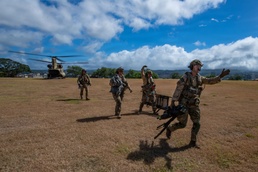
Casualties were transported from the point of injury by a diverse fleet of partner-nation aircraft and U.S. Army helicopters.
Significantly, the Canadian CMERT acted as the en route care asset, picking up casualties from the point of injury and treating them in the air aboard a U.S. Army CH-47 Chinook. Inside the cabin, Canadian emergency physician Capt. Richard Lee, flight nurse Major Nadine Verwey and paramedic Sergeant Nickolas Petuhoff performed aggressive, mid-flight resuscitations.
"The one that I was most involved in the care of was a patient who sustained facial trauma where they had a compromised airway," said Sgt. Nickolas Petuhoff, a Canadian Army reservist and civilian advanced care paramedic from Halifax. "They required some aggressive airway management... so they had a surgical airway."
The en route team also had to contend with aircraft variations that disrupted their standard operating procedures. Major Nadine Verwey, critical care nursing officer and commander of the forward air medical evacuation flight, noted that the U.S. Army Chinook had a large internal fuel tank, which reduced cabin space compared to Canadian aircraft.
"We weren't able to just do what we normally do," Verwey said. "We had to adjust our plan, which helps to build flexibility and resilience in the team."
Once the casualties crossed the threshold into the ship’s medical bay, they were met by a unified trauma team that had spent the preceding days actively ironing out communication and process bottlenecks.
"Somebody might call a piece of equipment a widget, and somebody else might call it a thingamabob," Foster said. "As soon as we got underway together, we got the team leaders together, and we paired up and grouped up the folks of the same skill types together to clarify and level-set all of those communications."
The team also implemented a radical, bottom-up process improvement suggested by a junior crew member to reverse the physical flow of patients through the triage spaces. By replacing standard hand-carried stretchers with rolling gurneys and establishing a strict, one-way directional flow, the team drastically reduced transit time between the flight deck, triage area, and operating rooms.
"As small a difference as that might seem on the outside, it is actually a really significant change that really improves patient flow," said Lt. Cmdr. Sebastian Vuong, a Canadian anesthesiologist and transfusion medicine specialist.
Inside the operating suites, the realism of the training was elevated by hyper-realistic cut suits.
"The surgeon can actually cut through with a real scalpel. There's actual organs inside that actually bleed," said Cmdr. Jesse Bandle, FST 5 officer in charge and Commander, Amphibious Task Force-Surgeon, Amphibious Squadron 5. "It really increases the level of fidelity of this surgical simulation."
Vuong, alongside an Army general surgeon, performed an emergency thoracotomy on a cut suit to open a patient’s chest, control massive lung bleeding, and administer blood transfusions. To manage resources efficiently, Vuong also provided ICU sedation for a bilateral leg fasciotomy on an electrical burn patient to save the limb, freeing up the operating rooms for other critical cases.
"It's really not about the medical clinical care; it’s about how to streamline the processes," Vuong said. "Medicine really has no uniform."
The drill also forced the medical staff to navigate the grim realities of mass casualty triage and resource limitations. Facing a patient with an unsalvageable head injury and exposed brain matter, providers pivoted to expectant care, administering pain medications for comfort while bringing in the ship’s chaplain to ensure a dignified passing.
For veteran land-based providers like Col. Dennis Turner, an Army nurse anesthetist with 25 years of service, practicing medicine afloat introduced unique, eye-opening challenges. "I learned that I can do resuscitative immersion care pretty much in any environment now, even aboard ship," Turner said. He noted that, unlike a land-based Army field hospital, where supply replenishment is constant, shipboard medicine is far more isolated. "It seems like it’s more resource-constrained here out in the middle of the ocean than we are on land. We don't have to worry about whether we're close enough to land to be able to receive more supplies and send away casualties."
While surgeons operated, the ship's dental crew activated a "walking blood bank," drawing fresh whole blood from the crew to sustain the trauma bay. Other teams managed complex abdominal laparotomies, packed open wounds, and stabilized severe pelvic fractures.
"I learned how to be a bit more fluent, control the chaos, both outside and on the inside, a little bit better," said Navy search and rescue medical technician HM3 Cole Krablin. "Stay ready, be ready."
Beyond the clinical success, the exercise highlighted the strategic advantages of utilizing an amphibious assault ship like the USS Essex for humanitarian aid and disaster relief missions. While dedicated hospital ships like the USNS Mercy offer extensive clinical space, they are slower to transit and rely heavily on civilian hospital staffing. The Essex offers a highly mobile, tactically flexible alternative, combining robust Role 2 surgical suites with the organic heavy-lift capabilities of the Marine Corps.
"The Essex provides a unique ability to really incorporate the extra assets from the Marine Corps as far as airlift, transport, and being able to put the Marines ashore to clear obstacles, restore operations at airfields, purify water, and transport food," Bandle said.
By the end of the RIMPAC exercise, the multi-service, multinational team had successfully rewritten the playbook for shipboard trauma care. At the patient’s bedside, the boundaries between the U.S. Navy, U.S. Army, and Canadian Armed Forces dissolved entirely, leaving behind a highly capable, unified force ready to face the world's next crisis.
"Medicine is a language that all of us speak with the same goal of providing excellent patient care," Verwey said.
Thirty nations, 30 surface ships, 5 submarines, 15 national land forces, more than 190 aircraft, and more than 30,000 personnel are participating in RIMPAC in and around the Hawaiian Islands, June 24 to July 31. The world's largest international maritime exercise, RIMPAC provides a unique training opportunity while fostering and sustaining cooperative relationships among participants critical to ensuring the safety of sea lanes and security on the world's oceans. RIMPAC 2026 is the 30th exercise in the series that began in 1971.