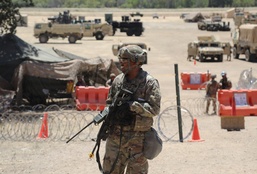
FORT HUNTER LIGGETT, Calif. — While Army Reserve units prepare to practice combat maneuvers during Operation Bold Eagle, another team ensured they have the equipment necessary to accomplish the mission before they ever departed the staging area.
For weeks, Soldiers assigned to the 645th Inland Cargo Transfer Company, an Army Reserve unit from Sloan, Nevada, operate the central receiving shipping point yard at Fort Hunter Liggett, California. They serve as the logistical gateway for thousands of pieces of military equipment, supporting one of the Army Reserve's premier annual training exercises.
Bold Eagle, a training exercise conducted July 14–23, provides mission command for 74 units and more than 3,300 Soldiers through a combined combat support training exercise and Global Medic, an international and joint medical training exercise. Bold Eagle immerses Army Reserve units in a realistic, multi-domain operational environment designed to prepare forces for large-scale combat operations.
For the 645th ICTC, the mission is straightforward in concept but complex in execution: receive, account for, organize, safeguard and redistribute the vehicles and equipment that participating units require throughout the exercise.
"The CRSP yard is essentially a central receiving and shipping hub," said Capt. Larry Subramanian, commander of the 645th ICTC. "Units moving into the exercise send their vehicles and equipment ahead of time, and we make sure everything is tracked, accounted for, organized and stored safely so they can retrieve it when they're ready to move forward."
As one of the first logistical touchpoints during the exercise, the CRSP yard serves as the bridge between commercial transportation assets and military tactical operations. Civilian transportation companies deliver equipment into the yard, where ICTC Soldiers verify documentation, inspect shipments, establish accountability and stage equipment for onward movement by military units.
Staff Sgt. Eric Mershon, a motor transport operator with the 645th ICTC, explained that every item entering the exercise passes through Soldiers who understand the complexities of cargo management and equipment handling.
"We receive the equipment, establish accountability and document everything to ensure each unit's property is properly tracked," Mershon said. "Once it's here, we organize it so military units can quickly retrieve what they need. Without someone managing that process, those units can't begin their missions.
The company operates specialized material handling equipment including forklifts, container handlers, loading ramps and rail-loading capabilities to safely move a wide range of cargo, from containers to tactical vehicles. Long before the first shipment arrives, Soldiers conduct detailed planning to organize the yard for efficient operations, maximizing space while maintaining safe traffic flow and accountability.
That level of planning directly supports operational tempo during large-scale exercises where delays in logistics can affect dozens of participating organizations.
"Every exercise depends on having a unit that knows how to receive, organize and distribute equipment," Mershon said. "We're here to support everyone else. It's a smaller mission compared to what some units are doing, but it's meaningful because we're helping them accomplish theirs."
Beyond supporting training, the mission reflects the Army's renewed emphasis on sustainment operations in contested environments. Modern warfare increasingly depends upon resilient logistics networks capable of rapidly moving personnel and equipment while adapting to emerging threats.
Subramanian said that reality has become increasingly evident as current conflicts demonstrate how rapidly technology is transforming the battlefield.
"Logistics is more important today than it has ever been," Subramanian said. "Our responsibility is to make sure frontline troops receive what they need when they need it. Customer service and accountability matter because every vehicle and every piece of equipment support Soldiers conducting operations forward."
He noted that Soldiers training today must also prepare for threats that extend beyond traditional combat operations.
"We're operating in an ever-changing environment," Subramanian said. "Drone warfare has become a significant part of modern conflicts. It's studied extensively, but many Soldiers are only now gaining practical exposure to how those systems influence operations. Today's battlefield isn't limited to conventional combat. Soldiers must understand cyber capabilities, electronic warfare and other asymmetric threats that shape how we fight."
While new technologies continue to reshape warfare, developing experienced Soldiers remains equally important.
For Mershon, mentoring junior Soldiers is one of the company's greatest responsibilities and one of its biggest training challenges.
"Most of our challenges come from being in a training environment," he said. "Some Soldiers haven't operated certain equipment or worked under these conditions before. That's why our noncommissioned officers spend so much time mentoring them, making sure they're confident and safe while learning."
Safety remains the command's top priority throughout every phase of operations.
"My number one priority is ensuring every Soldier goes home safely," Subramanian said. "Whether it's operating heavy equipment, moving vehicles or managing traffic in the yard, everything begins with safety."
The training also provides Army Reserve Soldiers with valuable civilian career skills. Experience operating forklifts, cranes, commercial cargo-handling equipment and military transportation systems often translates directly into employment opportunities in transportation, logistics, construction and commercial freight industries.
"The military gives Soldiers experience they can build on outside the Army," Mershon said. "Whether it's material handling equipment, cranes or truck driving, those certifications and that experience create opportunities in civilian careers while making them more capable Soldiers."
Operational readiness remains another defining characteristic of the 645th ICTC. As a unit required to maintain high readiness for rapid mobilization, the company regularly integrates Soldiers from eight additional Army Reserve units to augment its capabilities during annual training.
"Our Soldiers and augmentees have come together exceptionally well," Subramanian said. "Operationally, this unit has extensive experience conducting CRSP operations, and that's why we were selected to open and close the yard during Operation Bold Eagle. I'm fully confident in our ability to execute this mission."
As the Army Reserve continues preparing for large-scale combat operations, logistics units like the 645th ICTC provide the foundation that enables combat power to move where it is needed.
"We often focus on the Soldiers at the front," Subramanian said. "But they're supported by an entire logistics network that ensures they have food, equipment, supplies and vehicles. In future conflicts, we'll likely be operating far from home in unfamiliar environments. Units like ours are among the first to receive equipment into theater and the first to push it forward. That's why this mission is so important—not just for this exercise, but for the Army Reserve's ability to project combat power whenever and wherever the nation calls."