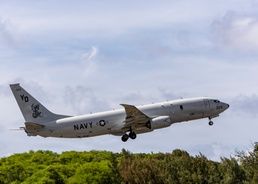
Above the vast waters of the Pacific, maritime patrol aircraft from across the region launch with a shared mission during Exercise Rim of the Pacific (RIMPAC) 2026: providing the fleet with a comprehensive picture of the maritime environment while strengthening the partnerships that underpin security throughout the region.
Operating under commander, Task Force (CTF) 172, maritime patrol and reconnaissance forces from the United States, Japan, Canada, Australia, Republic of Korea and India are working together throughout the world's largest international maritime exercise. While each nation brings its own aircraft and capabilities, RIMPAC provides an opportunity to integrate those strengths into a single, multinational force.
"RIMPAC 2026 key themes are Partners, Integrated and Ready," said Lt. Elizabeth Millward, exercise planning officer for Commander, Patrol and Reconnaissance Wing (CPRW) 10 and CTF-172 maritime patrol planner. "The exercise brings together a diverse array of naval surface, subsurface and air assets from numerous partner nations, allowing our crews to sharpen their expertise by working alongside multinational forces to detect and track submarines. This complex and realistic training environment challenges our teams, ultimately making us a more capable, ready and integrated force."
Although the U.S. Navy's P-8A Poseidon serves as a cornerstone of CTF-172's capabilities, it operates alongside partner aircraft including the Japan Maritime Self-Defense Force's P-1 Maritime Patrol Aircraft, the Royal Canadian Air Force's CP-140 Aurora, the Royal Australian Air Force's P-8A Poseidon and E-7 Wedgetail, Republic of Korea P-8A and the Indian Navy's P-8I.
Together, these aircraft fly missions ranging from anti-submarine warfare and anti-surface warfare to intelligence, surveillance and reconnaissance, search and rescue, and humanitarian assistance support. Their collective mission is to provide commanders with a real-time understanding of the maritime battlespace, enabling ships, submarines and aircraft from participating nations to operate safely and effectively across thousands of miles of ocean. "The P-8A's value in a complex exercise like RIMPAC stems from its unique blend of range, endurance, speed and advanced multi-mission sensors," Millward said. "Its ability to cover vast maritime areas and remain on station for extended periods makes it a persistent and powerful anti-submarine, anti-surface and intelligence, surveillance and reconnaissance platform."
Rather than operating independently, maritime patrol crews routinely exchange information and coordinate missions with allied and partner forces. This level of interoperability allows one nation's aircraft to seamlessly transfer responsibility for tracking a contact to another nation's crew, ensuring uninterrupted situational awareness throughout the exercise. "We practice seamless mission integration," Millward said. "When a Canadian CP-140 is tracking an underwater contact, it can flawlessly hand off that responsibility to a crew from South Korea, Japan or any other CTF-172 crew, ensuring continuous pressure on the target."
That cooperation extends beyond the tactical level. RIMPAC also features multinational task force staff and personnel exchanges designed to strengthen relationships and improve interoperability among participating nations. In some cases, aircrews are composed of personnel from multiple partner nations, demonstrating the common procedures, trust and professionalism developed through years of combined training.
"This year, we are taking it a step further with multinational crews, where an American P-8A might fly with personnel from several partner nations," Millward said. "This initiative proves that our training and procedures are so well aligned that our experts can integrate into any of our partners' aircraft and successfully execute the mission."
The scale of RIMPAC provides maritime patrol crews with a training environment difficult to replicate elsewhere. The concentration of ships, submarines and aircraft from multiple nations creates complex scenarios that challenge aircrews to coordinate across different platforms, organizations and operational environments while reinforcing the procedures that would be required during real-world operations.
Beyond improving tactical proficiency, those experiences strengthen the partnerships that remain central to the exercise's purpose.
"The P-8A Poseidon and the entire maritime patrol and reconnaissance community are at the forefront of ensuring regional stability and security," Millward said. "However, our greatest strength lies not just in our technology, but in our partnerships. Exercises like RIMPAC demonstrate that we are more effective when we operate together with our allies."
As RIMPAC continues, the aircraft flying above the Pacific do more than patrol the maritime domain. They build trust, refine interoperability and demonstrate the collective commitment of allied and partner nations to maintaining a free, open and secure Indo-Pacific.
Thirty nations, 30 ships, five submarines, 15 national land forces, more than 190 aircraft and more than 30,000 personnel are participating in RIMPAC in and around the Hawaiian Islands, June 24 to July 31. The world's largest international maritime exercise, RIMPAC provides a unique training opportunity while fostering and sustaining cooperative relationships among participants critical to ensuring the safety of sea lanes and security on the world's oceans. RIMPAC 2026 is the 30th exercise in the series that began in 1971.